
The Asian Gaming Market Analysis reveals why Asia remains the world's largest and most influential video game region. Home to industry leaders such as China, Japan, and South Korea, while rapidly expanding across India and Southeast Asia, the region continues to shape global gaming trends through innovation, massive player communities, and world-class game development.
The Gaming Industry in Asia has evolved far beyond mobile gaming. Artificial intelligence (AI), cloud gaming, cross-platform experiences, esports, live-service games, and extended reality (XR) are transforming how games are created, marketed, and monetized. At the same time, each Asian market has unique player preferences, regulations, payment ecosystems, and digital platforms, making localization essential for success.
For game developers, publishers, investors, and gaming brands, Asia is no longer a single opportunity it is a collection of highly diverse gaming ecosystems. Understanding these differences is the key to building sustainable growth in 2026 and beyond.
Overview of the Asian Gaming Market
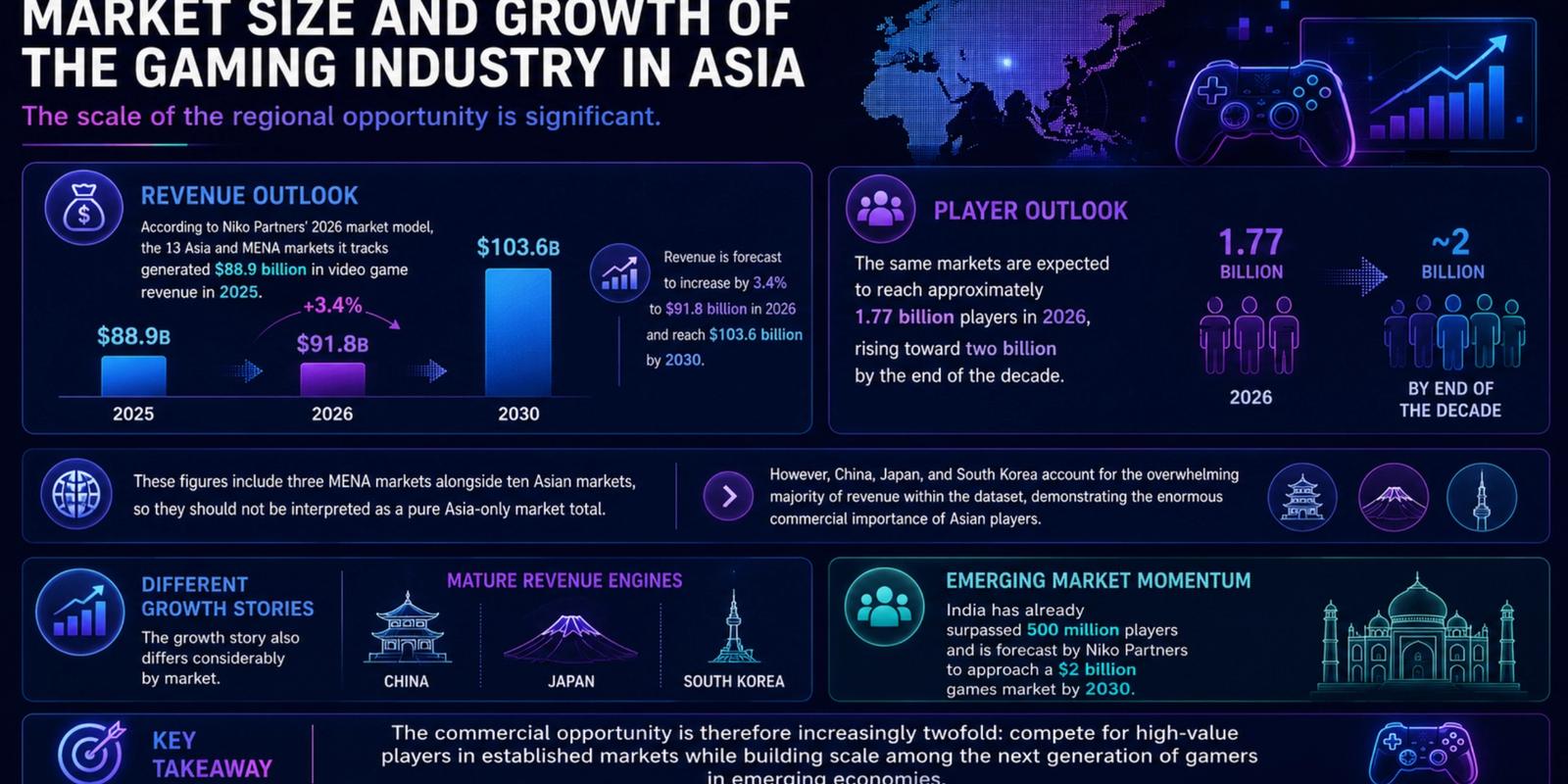
The Asian Gaming Market accounts for the largest share of global video game revenue and player activity. According to Niko Partners, the Asia and MENA markets it tracks generated approximately US$88.9 billion in gaming revenue during 2025 and are forecast to reach US$91.8 billion in 2026, with continued growth expected through 2030.
Although these figures include several Middle East and North Africa markets, Asia contributes the overwhelming majority of revenue. Asia's gaming ecosystem can generally be divided into two categories:
Mature Gaming Markets
Countries including China, Japan, and South Korea feature:
- High player spending
- Mature mobile and PC gaming ecosystems
- Strong first-party intellectual property (IP)
- Competitive esports industries
- Advanced digital payment infrastructure
These markets are highly competitive but offer significant monetization opportunities for premium titles and live-service games.
Emerging Growth Markets
India and Southeast Asia are experiencing rapid expansion driven by:
- Young populations
- Smartphone-first internet usage
- Affordable mobile devices
- Expanding digital payment systems
- Growing creator economies
While average revenue per user (ARPU) remains lower than in East Asia, these markets offer tremendous long-term growth potential due to their scale.
This combination of mature and emerging markets makes Asia unlike any other gaming region in the world.
Market Size and Growth of the Gaming Industry in Asia
The scale of the regional opportunity is significant.
The Gaming Industry in Asia continues to demonstrate remarkable resilience despite global economic uncertainty.
According to Niko Partners' 2026 Market Model, the 13 tracked Asia and MENA markets are expected to grow from:
- US$88.9 billion (2025)
- US$91.8 billion (2026 forecast)
- US$103.6 billion (2030 forecast)
The same report estimates approximately 1.77 billion gamers across these markets in 2026.
China remains the largest contributor to regional revenue, while India has surpassed 500 million gamers, making it one of the world's biggest gaming audiences.
Meanwhile, Southeast Asia continues to emerge as one of the fastest-growing gaming regions, supported by countries such as:Indonesia, Thailand, Vietnam, Philippines, Malaysia, Singapore.
Rather than competing solely for high-spending players, publishers increasingly view Asia as a portfolio of markets with different monetization strategies.
For example:
- China emphasizes premium content, esports, and live operations.
- Japan rewards strong IP and console experiences.
- South Korea remains a leader in competitive online games.
- India and Southeast Asia prioritize accessibility, mobile gaming, and community-driven engagement.
This diversity is one of Asia's greatest strengths—but also one of its biggest strategic challenges.
Key Trends Shaping Gaming in Asia
Several major trends are defining the gaming industry in Asia in 2026.
Cross-Platform Gaming Is Becoming Standard
Players increasingly expect to continue the same game seamlessly across mobile devices, PCs, and consoles.
Cross-platform functionality strengthens player retention while allowing publishers to build unified gaming ecosystems instead of separate audiences.
Games supporting synchronized progression, cross-play, and shared digital identities are becoming increasingly common across Asia.
Mobile Gaming Leads the Asian Market
Accessibility is one of the biggest reasons.
Smartphones allow consumers to play without purchasing dedicated gaming hardware. This has helped bring hundreds of millions of players into the market, particularly in mobile-first economies across India and Southeast Asia. Asia has moved from "mobile-first" to effectively "mobile-only" behavior, with approximately 1.5 billion smartphone users across the region .
Free-to-play business models further reduce the barrier to entry, while digital wallets and localized payment systems make in-game purchases easier.
Mobile games also fit naturally into the region's highly connected digital lifestyles. Social features, multiplayer modes, livestreaming, creator content, and frequent updates can keep players engaged beyond the game itself.
Mini games have become a major growth segment in China, now accounting for nearly 20% of mobile game spending . Platforms such as WeChat (with over 1.41 billion monthly active users) and Douyin remain dominant discovery channels, with mini games driven by instant play access, low development costs, and integrated social sharing loops
3. AI Is Changing Game Development
Artificial intelligence is beginning to reshape every stage of game production.
Studios are using AI for:
- procedural content generation
- NPC dialogue
- localization
- quality assurance
- customer support
- marketing asset creation
Rather than replacing developers, AI is accelerating production workflows and enabling studios to personalize player experiences more efficiently.
4. Creator-Led Discovery
Gaming influencers have become one of the most important customer acquisition channels.
Across China, Japan, South Korea, and Southeast Asia, players often discover new games through:
- livestreamers
- esports personalities
- YouTube creators
- Bilibili influencers
- Xiaohongshu creators
- TikTok and Douyin short-form videos
For international publishers entering Asia, influencer marketing is increasingly a core launch strategy rather than a supplementary promotional activity.
Growth of PC and Console Gaming Across Asia
Mobile may dominate player access, but PC and console gaming should not be overlooked.
PC gaming has deep roots in China and South Korea, supported by competitive multiplayer titles, esports, gaming cafés, and digital distribution platforms.
PC gaming has deep roots in China and South Korea, supported by competitive multiplayer titles, esports, gaming cafés, and digital distribution platforms. China drove 42% of global PC revenue growth in 2025, according to Newzoo.
The PC segment is benefiting from rising Steam adoption in China, stronger demand for premium PC titles, and increased engagement in social co-op gameplay systems.
Console gaming presents a different opportunity.
Japan remains the region's strongest traditional console market, but console adoption is gradually broadening across other parts of Asia. China's console market is approaching $2 billion, growing 16.7% year-over-year, with the Nintendo Switch as the best-selling console in the market.
The rise of cross-platform releases further reduces the boundaries between these categories. A player may discover a game on mobile, play competitively on PC, and experience a premium version on console.
For developers, platform strategy is therefore becoming less about choosing one device and more about designing connected player ecosystems.
The Rise of Esports and Competitive Gaming
Asia remains one of the world's most influential regions for esports.
Competitive gaming has developed into a major entertainment ecosystem supported by professional leagues, livestreaming, sponsorships, creators, and highly engaged fan communities.
MOBA games remain particularly influential. Niko Partners' analysis of esports activity in early 2025 identified MOBAs as the leading esports genre across tracked Asian markets, with titles including League of Legends, Mobile Legends, and Honor of Kings/Arena of Valor playing prominent roles.
Regional differences remain important. South Korea has a deeply established PC esports culture, China supports enormous professional gaming and livestreaming ecosystems, while mobile esports is particularly influential across Southeast Asia.
For publishers, esports can deliver value far beyond tournament revenue. A strong competitive ecosystem can extend a game's lifecycle, generate livestreaming content, strengthen community identity, and create opportunities for creators and sponsors.
The most effective esports strategies are therefore integrated into the broader game ecosystem rather than treated as short-term promotional campaigns.
Leading Gaming Markets in Asia
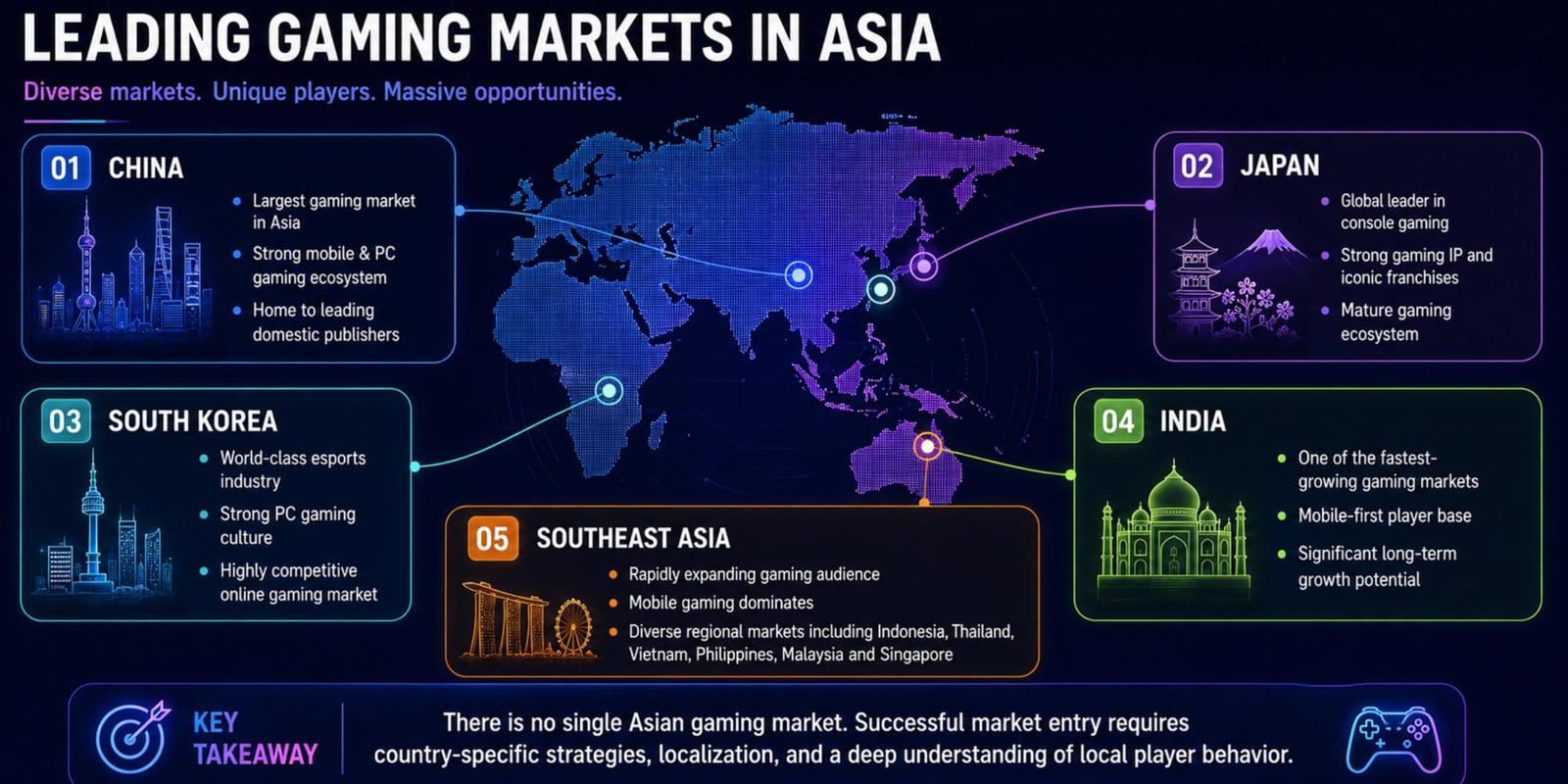
There is no single model for gaming success across Asia.
China remains the region's largest single-country video game market. It combines a huge player base with powerful domestic publishers, sophisticated mobile and PC ecosystems, and growing global influence. Tencent and NetEase continue strengthening global positioning through acquisitions and partnerships, while titles like Black Myth: Wukong highlight the international competitiveness of domestic studios.
Japan remains one of the world's most important markets for console gaming and globally recognized gaming IP. Its long-established development ecosystem continues to influence games worldwide.
South Korea is particularly strong in PC gaming, esports, and competitive online titles.
India represents one of the industry's largest long-term player-growth opportunities. Its enormous gamer population and mobile-first behavior make scale particularly attractive, although monetization dynamics differ from mature East Asian markets.
Southeast Asia is another major growth region. Indonesia offers enormous audience potential (144 million players by 2030), while Thailand ($2 billion by 2026), Vietnam (68 million players by 2030), the Philippines, Malaysia, and Singapore each have distinct player and platform characteristics.
The practical lesson is simple: an "Asia strategy" is not enough. Market entry should be built country by country.
Popular Game Genres Among Asian Players
Player preferences vary considerably across Asia, but several genres have established large audiences.
Role-playing games, MOBAs, battle royale titles, shooters, strategy games, simulation games, casual games, and puzzle titles all perform strongly in different parts of the region.
Competitive multiplayer games are particularly influential in China, South Korea, and Southeast Asia. Japan has historically maintained strong audiences for RPGs and character-driven franchises, while mobile-first emerging markets have created large audiences for accessible multiplayer and free-to-play experiences.
Recent esports data reinforces the strength of MOBAs, but genre popularity should never be generalized across the entire region.
For developers considering localization, understanding genre preference is only the first step. Art style, monetization, social mechanics, progression systems, cultural references, and live-event calendars may also need to be adapted to local expectations.
Emerging Technologies Transforming the Gaming Industry
Technology is creating new possibilities across the Asian gaming market.
Generative AI is increasingly being explored for game development, localization, personalized content, intelligent non-player characters, and player support.
Cloud gaming could make higher-quality games accessible without expensive local hardware, although network performance, latency, pricing, and sustainable business models remain important considerations.
Extended reality technologies including virtual reality, augmented reality, and mixed reality are also expanding the boundaries of interactive entertainment.
Meanwhile, cross-device technology is enabling players to move more seamlessly between mobile, PC, and console environments.
The most important test for any emerging technology, however, is whether it genuinely improves the player experience. Technology alone rarely creates a successful game. Strong gameplay, content, community, and emotional engagement remain fundamental.
Challenges Facing the Asian Gaming Industry
The scale of Asia's gaming market does not make it an easy market to enter.
Regulation remains one of the most significant challenges, particularly because rules around game approvals, content, data, monetization, and younger players vary between countries.
Competition is equally intense. Local publishers often have deep knowledge of domestic audiences and established relationships with platforms, creators, and communities.
Other challenges include rising user acquisition costs, platform fragmentation, localization requirements, different payment ecosystems, and the difficulty of maintaining long-term player retention.
Localization is particularly important.
Translating a game into a local language is rarely enough. Pricing, game mechanics, visual design, marketing messages, influencer partnerships, community management, and cultural references may all require adaptation.
Successful localization means understanding how people actually play not simply changing the words they read.
Future Outlook for Gaming in Asia
The outlook for gaming in Asia remains positive, but future growth will become increasingly diverse.
Mature markets such as China, Japan, and South Korea will continue competing through premium content, strong intellectual property, live-service strategies, and technological innovation.
Emerging markets will add millions of new players as smartphone access, internet infrastructure, digital payments, and consumer spending improve.
At the same time, the boundaries between games and other forms of digital entertainment will continue to blur.
Players increasingly move between gameplay, livestreams, esports, social media, creators, merchandise, and offline experiences. Successful gaming IP can therefore become the foundation for a much broader entertainment ecosystem.
For global gaming companies, the biggest opportunity may come from combining global scale with local depth.
Asia is not one gaming market. It is a collection of highly distinctive gaming cultures and understanding those differences will remain one of the most important competitive advantages in 2026 and beyond.
Frequently Asked Questions
What is driving the growth of the Asian gaming market?
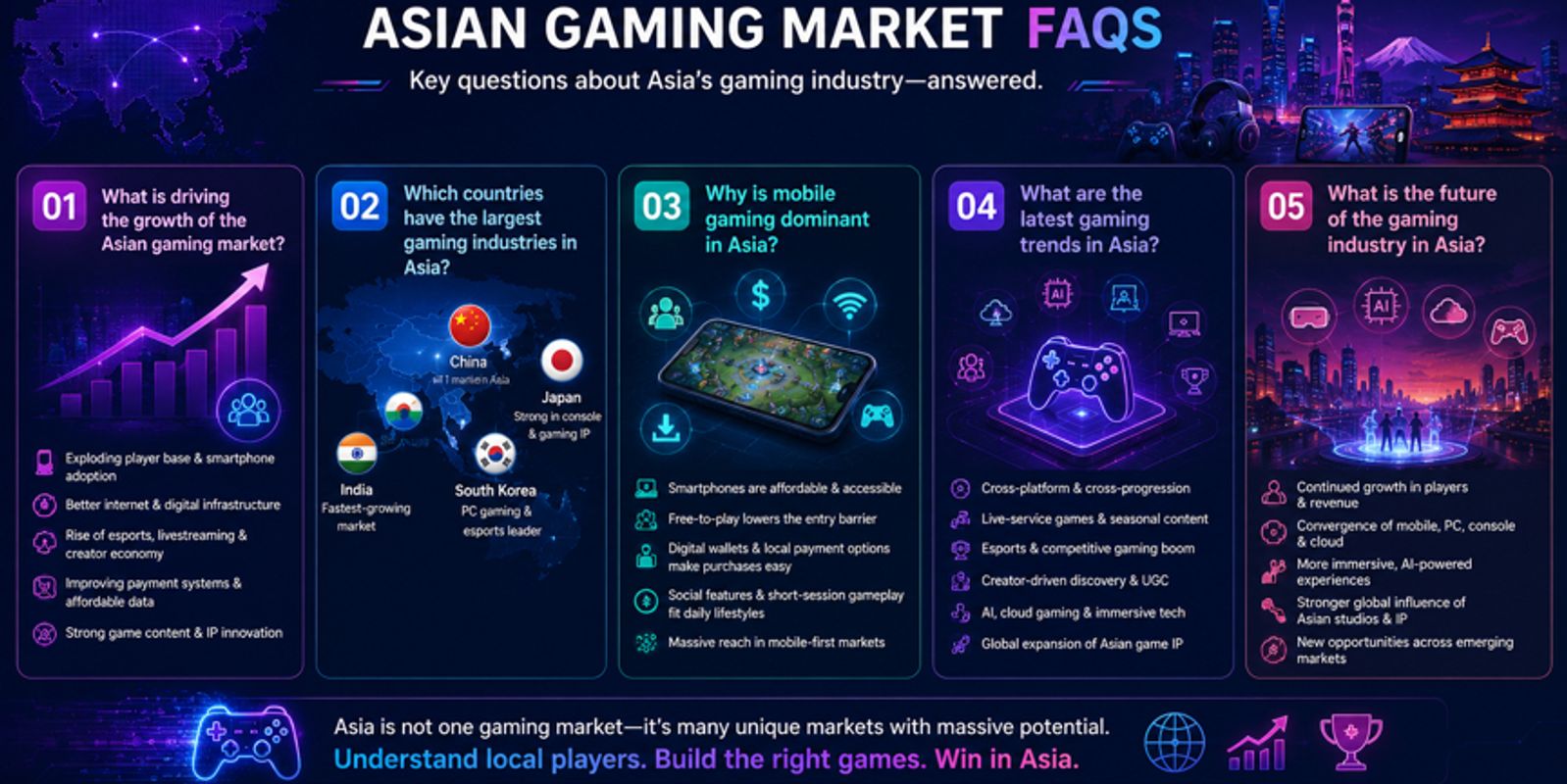
Growth is being supported by expanding player populations, widespread smartphone adoption, improved internet infrastructure, digital payment systems, esports, livestreaming, and continued innovation in game content and technology. Emerging markets such as India and Southeast Asia are contributing strongly to player growth.While China, Japan and Korea are projected to account for 89% of total revenue by 2030 at $91.7bn, the fastest growth sits elsewhere. India has crossed 500 million players and is set to become a nearly $2bn market by 2030.
Which countries have the largest gaming industries in Asia?
China is the largest single-country games market in Asia, reaching $51.8 billion in 2025. Japan and South Korea are also major gaming economies with strong console, PC, mobile, and esports ecosystems. India and Southeast Asian countries represent increasingly important growth opportunities.
Why is mobile gaming dominant in Asia?
Mobile gaming offers a relatively low barrier to entry because players can access games through smartphones without purchasing dedicated hardware. Free-to-play models, digital payments, social features, and frequent content updates have further supported mobile adoption. Asia has moved from "mobile-first" to "mobile-only" behavior, with approximately 1.5 billion smartphone users . Mini games alone now account for nearly 20% of mobile game spending in China.
What are the latest gaming trends in Asia?
Major trends include cross-platform gaming, live-service models, esports and livestreaming, creator-driven discovery, generative AI, cloud gaming, growing PC and console opportunities, and the global expansion of Asian-developed games and intellectual property.
What is the future of the gaming industry in Asia?
The future is likely to be defined by a combination of mature high-spending markets and rapidly expanding emerging player bases. Growth opportunities will increasingly center on strong IP, cross-platform ecosystems, long-term player engagement, technological innovation, and strategies adapted to individual Asian markets.