

Entering China remains one of the most significant growth opportunities for global brands, but success requires more than ambitionit demands a localized, data-driven approach. At China Digital Dynamics, extensive work with international companies has shown that a strong China market entry strategy must align with China’s unique digital ecosystem, regulatory environment, and consumer behavior.
China is not simply another expansion market. It is a highly competitive, platform-driven economy where foreign brands must adapt quickly or risk failure.
What Is China Market Entry?
Definition of Market Entry in China
China market entry refers to the structured process of introducing products or services into China through legal entities, partnerships, or digital commerce channels. This includes exporting, cross-border e-commerce, and establishing a local business presence.
Why China Is a Key Market for US Businesses
China continues to be a global consumption powerhouse. According to China’s National Bureau of Statistics:
- Total retail sales exceeded 50 trillion yuan (~$7 trillion) in 2025, positioning China among the world’s largest retail markets
- Online retail sales reached 15.97 trillion yuan, maintaining steady year-on-year growth
Additional key indicators:
- Over 900 million digital consumers
- E-commerce plays a dominant role in retail growth
- The digital economy contributes more than 40% of GDP
- China operates the world’s largest digital payments ecosystem
These factors make market entry into China a strategic priority for US companies seeking scalable, long-term growth.
Why Expanding into China Is Different from Other Markets
Unique Digital Ecosystem (No Google, Facebook, YouTube)
China operates within a closed internet ecosystem, where Western platforms are replaced by domestic alternatives. This requires a complete shift in digital strategy.
The rise of short-video platforms and livestream commerce has reshaped how brands engage consumers. Benefiting from a more sophisticated traffic ecosystem, deeper integration between livestream e-commerce and the real economy, and improved monetization efficiency among niche influencers, China’s influencer economy reached RMB 1.38 trillion in 2024, maintaining double-digit growth and demonstrating strong resilience.
Core monetization categories such as beauty, apparel, and home goods remain dominant, while lower-tier cities and the silver economy (older consumers) are emerging as key growth drivers. At the same time, AI-powered content tools are lowering barriers to entry, accelerating the growth of small and mid-sized creators.
China Influencer Economy Industry Classification
Category
Description
Entertainment & Creative Content
Focuses on comedy, creative videos, and talent-based content. Prioritizes entertainment value and shareability.
Knowledge & Educational Content
Delivers professional insights across areas such as law, finance, and technology, building trust through expertise.
Lifestyle & Consumer Content
Covers beauty, fashion, food, travel, parenting, and product recommendations, directly influencing purchasing decisions.
Niche Interest Content
Targets specific vertical audiences with high engagement and strong monetization efficiency.
Consumer Behavior Differences
Chinese consumers are:
- Mobile-first and digitally native
- Highly influenced by social proof and KOLs (Key Opinion Leaders)
- Active participants in livestream commerce
Livestream e-commerce generates hundreds of billions in annual GMV and has become a core sales channel for both domestic and international brands.
Regulatory and Legal Environment
China’s regulatory framework includes:
- Strict data and cybersecurity laws
- Industry-specific licensing requirements
- Cross-border trade policies
China is also focusing on expanding its services sector to 100 trillion yuan by 2030, signaling long-term opportunities for foreign companies.
In parallel, China is expanding its role in global digital trade through initiatives such as the Digital Silk Road (DSR) and participation in agreements like the CPTPP and DEPA. However, challenges remain, including data security concerns, evolving standards, and geopolitical considerations.
China Market Entry Strategies Explained
China’s digital economy continues to evolve rapidly, supported by strong government investment and widespread adoption of mobile internet technologies. With one of the world’s largest populations and a highly developed digital infrastructure, China offers significant opportunities for innovation, particularly in e-commerce and fintech.
- Exporting
Exporting allows companies to sell products into China without a physical presence. It is cost-effective but offers limited control over branding and distribution.
- Joint Ventures
Joint ventures provide access to local expertise and networks. This model is common in regulated industries but requires careful management of intellectual property.
- Wholly Foreign-Owned Enterprise (WFOE)
A WFOE offers full ownership and operational control. It is suitable for companies planning long-term investment in China but involves higher setup costs and regulatory complexity.
- Licensing and Franchising
Licensing enables local partners to operate under a foreign brand. This model is often used in retail and food sectors.
- Cross-Border E-commerce
Cross-border e-commerce is one of the most efficient market entry strategies for China. Latest growth is fueled by comprehensive pilot zones, digital technology, and strong supply chains. Cross-border e-commerce imports and exports reached 2.63 trillion yuan, growing over 10% year-over-year in 2024.
This model allows foreign brands to sell directly to Chinese consumers without establishing a local entity.
How to Choose the Right Market Entry Strategy
Based on Budget
- Entry-level: Cross-border e-commerce
- Mid-level: Distributor partnerships
- High investment: WFOE or joint venture
Based on Industry
Highly regulated industries often require partnerships, while consumer brands can leverage digital-first approaches.
Based on Risk Level
Lower-risk strategies involve indirect entry, while higher-risk strategies offer greater control and long-term returns.
Based on Speed to Market
Cross-border e-commerce enables rapid launch, while legal entity setup requires longer timelines.
Step-by-Step China Market Entry Plan
Step 1: Market Research
Market validation is critical. China’s retail sector is projected to continue expanding, supported by rising disposable income and digital consumption.
Step 2: Competitor Analysis
Local competitors are highly agile and digitally sophisticated. In sectors like pet food, China’s market reached $24 billion in 2026, with domestic brands gaining share.
Step 3: Platform Selection (eg. WeChat, Douyin, Xiaohongshu)
Platform selection determines marketing success:
- WeChat: CRM and private traffic
- Douyin: Short video and livestream sales
- Xiaohongshu (RED): Product discovery and reviews
Step 4: Localization Strategy
Effective localization includes:
- Language adaptation
- Cultural alignment
- Product customization
- Pricing strategy
Step 5: Launch and Marketing Execution
Successful launches rely on:
- Influencer (KOL) campaigns
- Livestream commerce
- Paid advertising and SEO
- Localization content
Key Challenges of Entering the Chinese Market
Legal and Regulatory Barriers
Regulations frequently evolve, requiring continuous monitoring and compliance.
Cultural and Language Differences
Misaligned messaging can reduce brand credibility and impact performance.
Strong Local Competition
Domestic brands are fast-moving and deeply connected to local trends.
Platform Restrictions
Each platform operates with unique algorithms and policies, requiring tailored strategies.
Cost of China Market Entry
Setup Costs
- WFOE registration: typically $20,000–$100,000+, including capital and service fees
- Legal and compliance expenses
Marketing Costs
Sustained investment is required for paid media, content production, and platform management.
Influencer (KOL) Costs
Top influencers can command significant fees, particularly for livestream campaigns.
Ongoing Operational Costs
Includes staffing, logistics, platform management, and customer service.
Best Marketing Channels for Entering China
WeChat Marketing
WeChat is essential for customer relationship management and brand communication.
Douyin (TikTok China)
Douyin drives discovery, engagement, and direct sales through short-form video and livestreaming.
Xiaohongshu (RED)
Xiaohongshu is critical for building trust through user-generated content and reviews.
SEO and Ads and AI SEOBaidu remains the primary search engine for brand visibility and credibility, with AI SEO in China increasingly shaping how content is optimized for ranking, summaries, and AI-driven search results.
Case Examples of Successful China Market Entry
Example of a US Brand Success
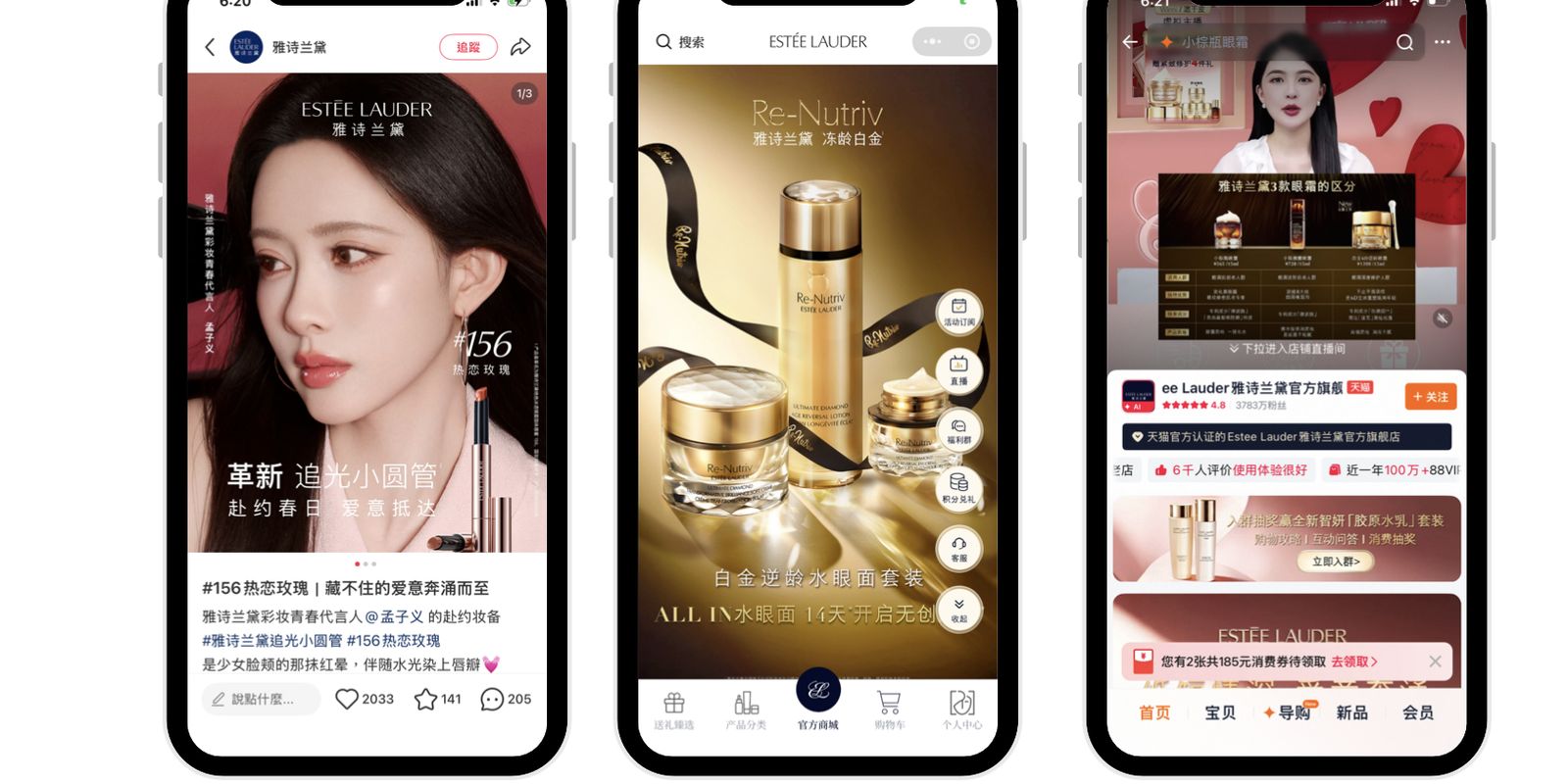
A US beauty brand such as Estée Lauder demonstrates how a well-executed China market entry strategy can drive rapid, scalable growth through a digital-first approach. Instead of relying on traditional retail, the brand entered via cross-border e-commerce, launching an official flagship store on Tmall Global as its primary sales channel. This allowed direct access to Chinese consumers without the need for immediate local entity setup, reducing regulatory complexity and accelerating time to market.
To build trust and awareness, the brand invested heavily in Xiaohongshu, leveraging influencers to create authentic reviews and product tutorials. At the same time, livestream campaigns on Douyin drove engagement and conversions through real-time interaction and promotions.
Beyond acquisition, the brand established a strong owned ecosystem through WeChat, using it for CRM, membership programs, and customer retention. A localized Chinese website further reinforced brand credibility and supported integrated digital marketing efforts.
This multi-channel strategy enabled rapid validation, strong brand positioning, and scalable.
Do You Need a China Market Entry Partner?
When to Hire a Local Agency
A local partner is valuable when navigating regulatory requirements, platform ecosystems, and cultural nuances.
Benefits of Working with Experts
- Faster market entry
- Reduced risk
- Access to local networks and influencers
What to Look for in a China Market Entry Partner
- Proven experience with foreign brands
- Platform expertise
- Transparent processes and pricing
Frequently Asked Questions (FAQs)
What is the best way to enter the Chinese market?
Cross-border e-commerce is often the most effective starting point due to lower risk and faster execution.
How much does it cost to enter China?
Typical initial investment ranges from $30,000 to $100,000+, depending on the chosen strategy.
Can US companies sell directly in China?
Yes, especially through cross-border e-commerce platforms, which allow direct-to-consumer sales without a local entity.
Final Thoughts on China Market Entry Strategy
China remains a highly attractive yet complex market. Growth is increasingly driven by digital commerce, evolving consumer behavior, and continued government support for innovation and services.
China’s digital economy is entering a new phase balancing rapid technological advancement with regulatory development in areas such as data privacy, cybersecurity, and intellectual property protection. At the same time, ongoing investment in infrastructure and emerging technologies continues to drive industrial upgrading and digital transformation.
At China Digital Dynamics, successful companies consistently adopt a localized, platform-first approach. A strong China market entry strategy requires adaptability, strategic investment, and a deep understanding of China’s unique business environment.
For US companies aligned with these dynamics, the opportunity in China remains substantial in 2026 and beyond.