
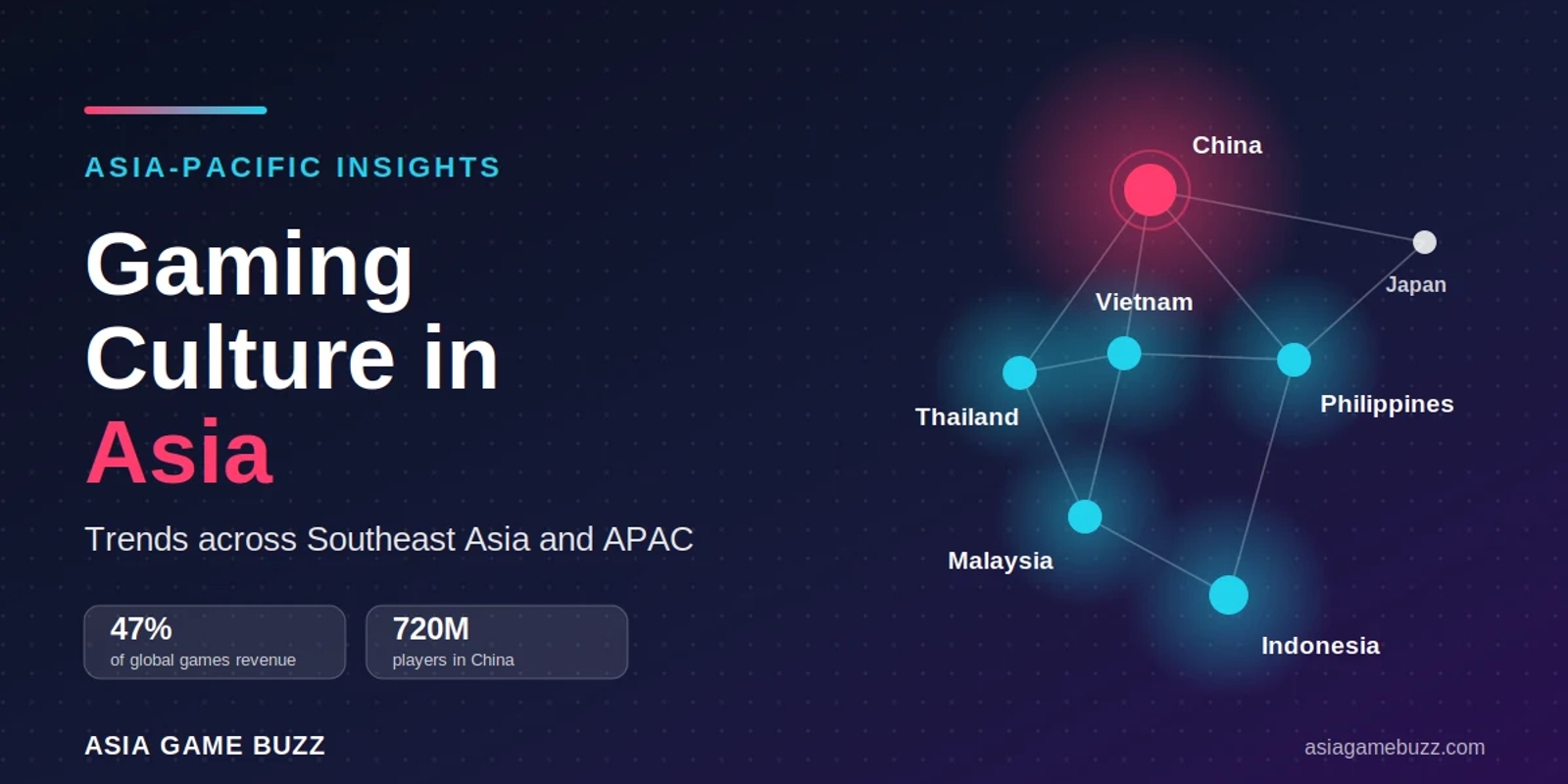
Gaming culture in Asia is not one culture. It is dozens of local habits, platforms and communities that share one trait: games are social, mobile-friendly and deeply tied to how people discover entertainment. For developers and publishers, that matters because Asia-Pacific is the largest region in the industry. Asia-Pacific is expected to remain the largest regional games market in 2026, generating $100.7 billion, or 47% of global revenue. medianews4u
This guide explains how gaming cultures differ across Southeast Asia and the wider Asia-Pacific region, where China fits, and why developers who skip cultural research tend to fail on launch.
What Is Gaming Culture in Asia?
Gaming culture is the mix of platforms, genres, communities, creators and social norms that decide how people find, play and talk about games. In Asia, those factors vary sharply by country, which is why one regional launch plan rarely works.
How Gaming Became Mainstream Across Asia-Pacific
Gaming is now everyday entertainment in the region. Newzoo expects 3.7 billion players worldwide in 2026, and China and the US together will account for 52% of consumer spending. Asia’s scale comes from both large populations and rapid smartphone adoption. Substack
Mobile, PC and Console: Where Asian Players Spend Their Time
Mobile is the entry point for most players. Of the 3.7 billion players globally, about 3.1 billion play on mobile (84%), compared with 977 million on PC and 651 million on console. Console remains strongest in Japan, PC in China and South Korea, and mobile across Southeast Asia and India. gamesbeat
How Communities Shape What Players Play
Players rarely pick games alone. Group chats, clan servers, livestreams and local creators drive recommendations. The Comscore 2020 snapshot of the region found a highly fragmented ecosystem, with few gaming sites above 5% reach and many above 1%. Malaysia was among the most fragmented markets, while India, Australia and Vietnam were more concentrated. That data is dated, but the lesson holds: no single channel reaches everyone. comscore
Gaming Cultures in Southeast Asia
Southeast Asia is young, mobile-first and social. It ranked as the second-largest market for mobile game downloads in Q1 2025, with 1.93 billion installs. Its revenue is smaller than its audience suggests: the six core markets (Indonesia, Malaysia, the Philippines, Singapore, Thailand and Vietnam) generated more than $5.6 billion in 2025, up 4.7%. sensortowertech-insider
Indonesia: Mobile Scale and Online Communities
Indonesia led the region with 870 million mobile game downloads in Q1 2025. It is also the largest market by player count, with more than 126 million gamers. Squad play, local creators and community groups drive discovery. sensortowernikopartners
The Philippines: Multiplayer and Esports Fandom
The Philippines followed with 366 million downloads. Social, team-based games and esports viewing are central to how players engage. sensortower
Vietnam: Competitive Play and Viral Hits
Vietnam recorded 329 million downloads in the same quarter. Sensor Tower describes it as a hotbed of new, highly viral hits. sensortowerSubstack
Thailand: Spending, Streaming and Esports
Thailand punches above its size on monetization. It led Southeast Asia in mobile gaming revenue in Q1 2025 at $162 million, supported by strong digital payments and a culture of social, play-focused in-app spending. seenthis
Malaysia and Singapore: Diverse Audiences and Digital Communities
These are smaller, higher-income, multilingual markets. Audiences split across Malay, Chinese and English-language communities, so localization and creator choice matter more than raw reach.
Esports ties the region together. Garena says Southeast Asia has over 200 million esports viewers, with Vietnam, Thailand and Indonesia as key hubs, and esports is now a medal sport at the Southeast Asian Games. pocketgamer
Where Asia-Pacific Sits in the Global Games Market
Asia-Pacific is not just large; it is where revenue concentrates. After the $100.7 billion regional total above, Newzoo projects mobile will reach $121.1 billion globally and PC $45.9 billion in 2026. Growth is also shifting from player acquisition to retention. Newzoo notes that global mobile downloads fell 25% year over year in H1 2026 while cost per install rose 30%. Cultural fit now matters more than paid reach. gameworldobserverpocketgamer
Gaming Culture in China
China is the region’s biggest single market and the one where local knowledge matters most.
Who Are Chinese Gamers?
China’s players spent $51.8 billion in 2025, and Niko Partners projects 4% growth to $53.9 billion in 2026. About 720 million people play games in the country. Mobile leads, but PC is rising: China accounted for 42% of global PC revenue growth in a recent year. Mobile mini-games reach roughly 650 million players. niko partners the chinese gaming 2cc +3
Where Chinese Gamers Spend Time Online
Discovery runs through Chinese platforms, not Western ones: Bilibili, Douyin and Xiaohongshu for video and reviews; QQ groups and WeChat for community; TapTap, Xiaoheihe and NGA for discussion. For PC, nearly 80% of premium PC players use Steam, mostly the international version without a VPN, and short video is a main route to discovering new games. This is why <a href="https://asiagamebuzz.com/services/social-media">social media marketing for games in China</a> has to be built natively on these platforms. games
Esports and Game Streaming
Esports is mainstream. In 2026, 51.3% of players in China engage with esports in some way, up from 46.5% a year earlier. Huya, Douyu, Bilibili Live and Douyin Live host streamers, and “UP主” (video creators) shape which games trend. A tailored <a href="https://asiagamebuzz.com/services/influencers">KOL and influencer marketing campaign</a> is often the fastest route to credibility. Substack
How Regulation Shapes the Market
Minors face strict limits: online game services may be offered to under-18s for one hour, 8 to 9 p.m., on Fridays, weekends and legal holidays only. Separately, paid mobile and online releases face a licensing process, while the PC and Steam channel works differently. Check current requirements with a local partner before planning a launch. sixthtone
How Gaming Culture Differs Across Asia
Market
What defines it
Marketing implication
Southeast Asia
Mobile-first, social play, esports viewing
Local-language creators, community groups, lightweight builds
China
Short video, Steam PC growth, QQ/WeChat communities
Chinese platforms, KOL/KOC seeding, localized store pages
Japan
Console culture and iconic franchises
Franchise and media-led PR, careful localization
South Korea
PC and competitive play, strong esports
Streamer and community-led launches
India
Mobile-first, large and varied player base
Regional-language content, mobile-optimized campaigns
Language, memes and community norms differ even within one country, so translation alone is not localization.
What Gaming Culture Means for Your Marketing
Localize beyond translation. Adapt tone, humor, art, pricing and store pages for each market.
Pick the right platforms. What works in Jakarta will not work in Shanghai. Choose channels per market.
Build community before launch. Players trust peers and creators over ads. With downloads falling and acquisition costs rising, retention and community matter more than ever. Professional <a href="https://asiagamebuzz.com/services/community">community management on QQ and WeChat</a> gives you a base of players before launch day. pocketgamer
Earn local coverage. Chinese press and gaming media lend credibility that Western coverage cannot. Targeted <a href="https://asiagamebuzz.com/services/public-relations">game PR and press release distribution in China</a> puts your title in front of the right editors and communities.
FAQ About Gaming Culture in Asia
What is gaming culture in Asia?
It is the set of platforms, genres, communities and creator ecosystems that shape how people play and discover games across Asia-Pacific. It varies widely by country.
How does gaming culture differ across Southeast Asia?
Indonesia is the volume leader, the Philippines and Vietnam are social and competitive, Thailand leads on spending, and Malaysia and Singapore are smaller, multilingual markets.
Which types of games are popular in Southeast Asia?
Mobile multiplayer and competitive titles dominate. Local hits vary by country, so check current charts for each market.
How important is mobile gaming in Asia?
Very. It is the main way most players across Southeast Asia and India access games, and it is also the largest segment in China.
How is Chinese gaming culture different from Southeast Asia?
China relies on its own platform ecosystem (Bilibili, Douyin, QQ, WeChat), has a growing Steam PC audience and operates under distinct regulation.
How can developers market games in Asia?
Research each market, localize fully, use local creators and press, and build a community before launch.
Conclusion: Win Asia’s Gamers by Understanding Them First
Asia-Pacific is the largest games region, but it is a patchwork of cultures. Southeast Asia rewards mobile-friendly, social, locally voiced campaigns. China rewards deep platform knowledge, Chinese-language content and community. Developers who treat Asia as one audience waste budget.
If you are planning a China launch, talk to the team at Asia Game Buzz. We help developers and publishers combine game PR in China, KOL and influencer marketing, gaming community management and social media marketing for games into one localized go-to-market plan.