
How Is the Gaming Industry Evolving in China? Trends, AI, Mini Games & What's Next
If you follow the global games business, you’ve probably asked: how is the gaming industry evolving in China — and why does it matter?
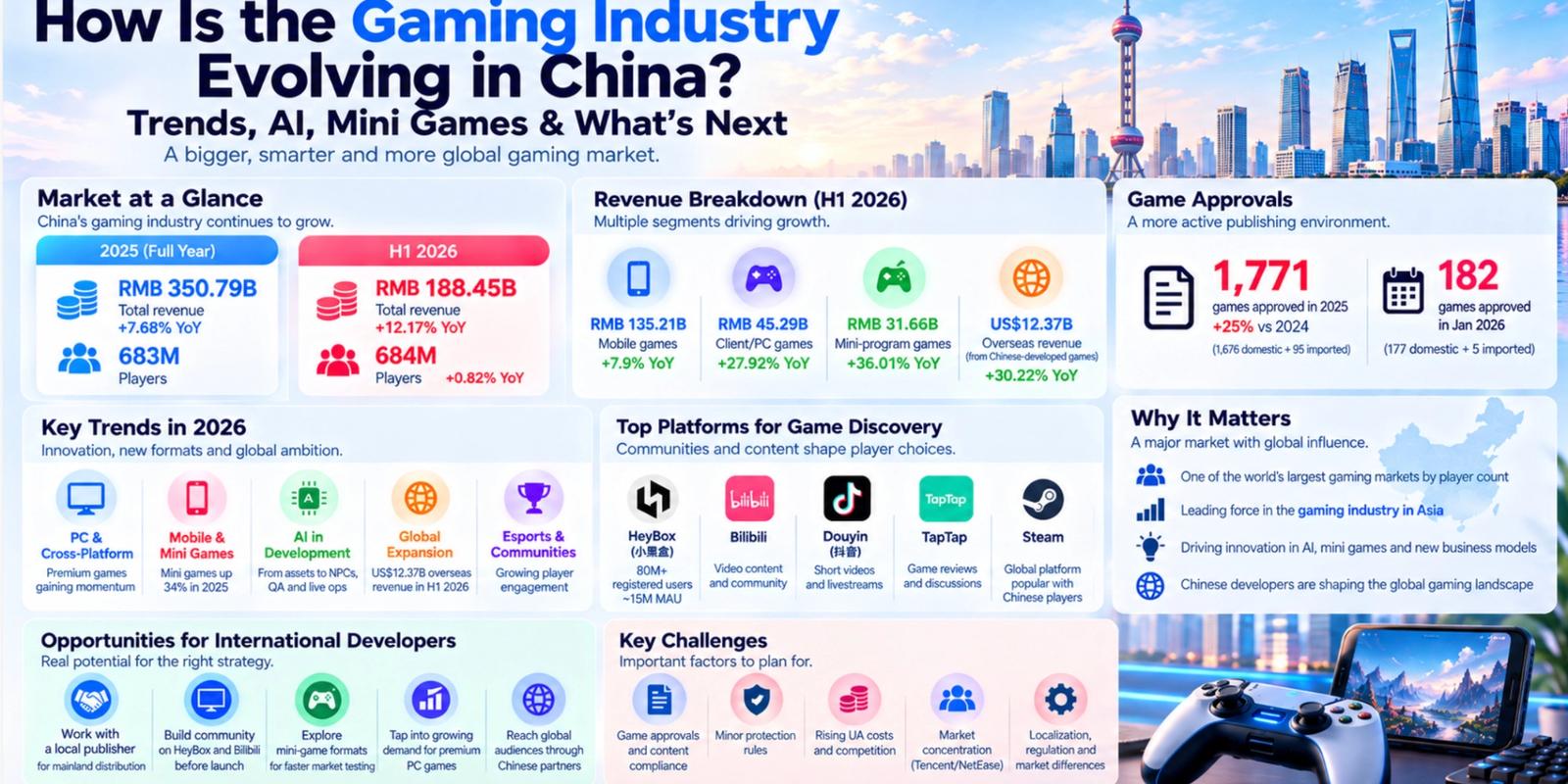
The short answer: China’s gaming market is becoming more diverse, more technology-driven and more global. In 2025, domestic game revenue reached a record RMB 350.79 billion, up 7.68% year on year, while the number of players reached 683 million.
And that momentum has continued into 2026. In the first half of the year, domestic game revenue reached RMB 188.45 billion, up 12.17% year on year, while the player base increased to 684 million. PC/client games, mini games, AI-powered development and overseas expansion are all becoming more important parts of the industry.
Here’s what that evolution looks like in 2026.
Overview of China’s Gaming Industry
China remains one of the world’s largest and most commercially important gaming markets.
According to the 2025 China Game Industry Report, domestic game revenue reached RMB 350.79 billion, while the number of players climbed to 683 million — both record highs.
By the first half of 2026, the market had moved further:
- Domestic game revenue: RMB 188.45 billion, +12.17% YoY
- Players: 684 million, +0.82%
- Self-developed games in China: RMB 163.36 billion, +16.31%
The interesting part is that revenue is growing much faster than the player population. China is already a mature gaming market, so the next phase of growth increasingly depends on better games, stronger monetization, new formats and international expansion rather than simply adding new users.
Tencent and NetEase remain major forces, but companies and studios including HoYoverse, Game Science, Lilith Games and a growing number of mid-sized developers have helped broaden China's development ecosystem.
Why China Is a Major Gaming Market in Asia
Within the broader gaming industry in Asia, China leads on three fronts: sheer scale (more players than the US and Europe combined), mobile-first monetization models exported across the region, and production power — Chinese studios now compete directly with Japanese, Korean, and Western publishers worldwide.
How China’s Gaming Industry Is Changing in 2026
The story of 2026 is diversification rather than simple user growth.
Mobile remains the foundation of the market, but client games, cross-platform titles, mini games and overseas releases are creating new sources of growth.
The publishing environment has also become more active. China issued 1,771 game approvals in 2025, including 1,676 domestic and 95 imported titles, up about 25% from 1,416 approvals in 2024. January 2026 then opened with another 182 approved titles.
At the same time, AI is moving deeper into game development. Industry reporting on the first half of 2026 describes AI as increasingly penetrating the game-production chain, supporting efficiency while also changing development workflows and player experiences.
Key Trends Shaping the Chinese Gaming Industry
Growth of PC and Cross-Platform Gaming
One of the clearest shifts is the renewed momentum behind PC/client and cross-platform games.
The success of titles such as Black Myth: Wukong showed that Chinese studios can compete internationally in premium game development, while publishers are increasingly designing games to operate across mobile and PC rather than treating each platform separately.
The approval data reflects this direction too. In 2025, 136 multi-platform games received approvals, up from 110 in 2024. Many covered both mobile and PC/client platforms.
For developers, the takeaway is simple: China is still mobile-first, but it is no longer a mobile-only opportunity.
Rise of Mobile and Mini Games
Mobile remains the backbone of Chinese gaming, but mini games are one of the most interesting growth areas.
These lightweight titles can be accessed through ecosystems such as WeChat without the same traditional download journey as standalone games. That creates a low-friction path between discovery and gameplay.
Mini games generated RMB 53.5 billion in 2025, up 34.4% year on year, and continued their rapid expansion into 2026.
Growing Use of AI in Game Development
Chinese studios deploy generative AI across NPC dialogue, art pipelines, QA, localization, and live-ops personalization — a key competitive advantage for overseas expansion.
Expansion of Chinese Games Overseas
Going global — often referred to as chuhai — is no longer a side project for China's biggest publishers.
It has become a core growth strategy.
Chinese developers are building games with international audiences in mind from much earlier in the production process, while localization, overseas publishing, creator marketing and community management are becoming more sophisticated.
This shift also means that Chinese studios increasingly compete directly with Japanese, Korean, European and North American developers for the same global players.
Growth of Esports and Gaming Communities
Esports remains highly visible, with titles such as League of Legends and Honor of Kings supporting major competitive ecosystems.
But the broader gaming-community landscape is equally important.
Platforms including HeyBox, TapTap and Bilibili influence how Chinese players discover games, watch gameplay, compare titles, discuss updates and react to launches.
For publishers, these communities are not simply promotional channels. They can also provide an early indication of how local players understand and respond to a game.
How AI Is Transforming Game Development in China

AI is moving from experiment to infrastructure. Four high-impact uses: AI-assisted content production, LLM-driven intelligent NPCs, real-time live-ops personalization, and AI-accelerated localization for overseas markets. For foreign developers, matching Chinese studios’ AI-driven shipping cadence is becoming a baseline requirement.
The Rise of Chinese Game Developers and Publishers
A decade ago, Chinese studios were known for licensed mobile titles and outsourcing. Today: Game Science is a global name, HoYoverse earns billions annually from original IP, and Tencent and NetEase operate as global publishers with studios worldwide.
How Chinese Games are Expanding into Global Markets
The winning overseas playbook: deep localization (not just translation), focus on Southeast Asia, the Middle East, and Latin America, strength in strategy/SLG genres, and transmedia IP extension into anime and merchandise.
What Makes the Gaming Industry in Asia Different?
For Western publishers, China differs fundamentally: fragmented Android distribution (no Google Play), super-app ecosystems, mandatory ISBN licensing, community-driven discovery, and distinct monetization norms.
How Game Marketing is Evolving in China
Marketing has shifted from pure paid UA to a content- and community-led model: short video and livestreaming for awareness, community seeding for credibility, KOL campaigns for trust — and PR to tie it together.
The Growing Role of Video Game PR in China
Video game PR in China blends media relations with community platforms and creators. Chinese players research heavily — reading reviews and checking community sentiment before spending — so PR directly drives wishlists, store featuring, and conversion.
How Video Game PR Helps Games Reach Chinese Players
A modern program combines games-media outreach, community management on HeyBox/TapTap/Bilibili, KOL campaigns on Douyin and Bilibili, and post-launch sentiment management. Done well, strong community sentiment compounds into better featuring and lower UA costs.
HeyBox China: A Key Platform for Game Discovery and Communities
For PC publishers, HeyBox China deserves particular attention.
HeyBox combines game discovery, gaming news, communities, Steam-linked features and commerce. According to Sekkei Digital Group, the platform has 80 million registered users, around 15 million monthly active users and more than 1,500 onboarded developers.
The platform is particularly relevant because Steam data alone may not show the full picture of Chinese interest in a PC game. Players can track and wishlist titles within HeyBox itself, giving developers another place to understand local demand.
For overseas publishers, that makes HeyBox useful not only for promotion but also for understanding community interest before and after launch.
How Developers Can Use HeyBox to Promote Games
- Claim and localize your game page with quality Simplified Chinese assets.
- Seed the community early with dev updates and trailers.
- Run key giveaways, wishlist events, and store promotions.
- Monitor sentiment as an early-warning system.
- Coordinate HeyBox activity with Bilibili and Douyin KOL campaigns.
Influencer and KOL Marketing in China’s Gaming Market
KOLs are the trust layer: Bilibili uploaders, Douyin creators, and livestreamers. Best practices: match creator to genre, brief rather than script, layer large KOLs with mid-tier creators, and measure wishlists and sentiment — not just views.
Challenges Facing the Chinese Gaming Industry
Key headwinds: ISBN licensing and content compliance, strict minor-protection rules (71% of minors kept within the three-hour weekly limit in 2025), rising UA costs, Tencent/NetEase market concentration, and occasional geopolitical friction.
Gaming Regulations and Their Impact on Developers
The good news: regulation is now predictable. Approvals hit 1,771 in 2025 (up ~25% YoY), with imported titles — including Astro Bot and Dave the Diver — approved on a roughly monthly cadence. Foreign developers need a Chinese publishing partner for ISBN access and should build compliance review into production early.
Future of the Gaming Industry in China
Expect steady growth toward ~$60 billion by 2030, deeper AI integration, continued premium PC momentum, and aggressive, policy-supported overseas expansion — in a strict but stable regulatory environment.
Opportunities for International Game Developers in China
Steam’s accessible international version plus HeyBox community building offers a low-friction entry; formal licensing is viable again with a local partner; premium PC demand is growing; and WeChat mini games offer a low-cost market test.
Final Thoughts
So, how is the gaming industry evolving in China?
It's becoming broader, smarter and more global.
Mobile remains the industry's foundation, but PC and cross-platform games are gaining momentum. Mini games are opening new ways to reach players. AI is moving deeper into development workflows. And Chinese studios are increasingly designing games and IP for global audiences from the start.
The numbers reinforce that shift: China's gaming market reached RMB 188.45 billion in H1 2026, up 12.17% year on year, even as the player population grew by less than 1%.
For international developers, the opportunity is significant — but success requires local fluency. That means understanding Chinese regulations, choosing the right platforms, adapting content and building genuine relationships with gaming communities rather than relying on a translated version of a global campaign.
Planning to launch in China? Get in touch with Asia Game Buzz for a free consultation on your China go-to-market strategy.