
Launching a game has never been easier—and getting players to discover it has never been harder.
Learning how to market your video game is now just as important as developing it. Every year, thousands of games launch across Steam, PlayStation, Xbox, Nintendo Switch, mobile app stores, and cloud gaming platforms. Even exceptional games can struggle to gain traction without a clear marketing strategy.
Game marketing is evolving rapidly. AI-powered tools are helping developers streamline content creation, audience research, localization, and community analysis. However, successful marketing still depends on something AI cannot replace: authentic relationships with players and communities.
At Asia Game Buzz, we've worked across both Western and Asian gaming ecosystems, and one lesson consistently stands out: great games are discovered because developers actively build awareness long before launch.
This guide explores practical, proven strategies for indie developers to increase visibility, grow communities, attract Steam wishlists, and create long-term momentum.
Why Marketing Your Video Game Is Just as Important as Making It
The Harsh Reality of Game Discoverability
The gaming industry has become increasingly crowded.
Steam regularly exceeds 40 million concurrent users, while thousands of new games launch annually. Although the platform offers enormous opportunities, it also creates intense competition for player attention.
Many excellent games fail not because they are poorly made, but because players never discover them.
Modern game discovery is heavily influenced by:
- Social media platforms
- Steam algorithms
- Content creators and streamers
- Gaming communities
- User-generated content
- Livestreams and esports events
- Influencer recommendations
In 2026, discoverability is no longer a launch-week challenge. It is an ongoing process that begins long before release and continues long afterward.
When Should You Start Marketing Your Game?
One of the biggest mistakes indie developers make is waiting until launch to begin marketing.
Ideally, marketing should start as soon as your game has a clear concept, visual identity, and playable prototype.
Starting early allows developers to:
- Build wishlists gradually
- Gather community feedback
- Improve visibility in platform algorithms
- Establish creator relationships
- Refine messaging over time
A good rule of thumb is to begin marketing at least six to twelve months before launch.
The earlier you start, the larger your audience can become by release day.
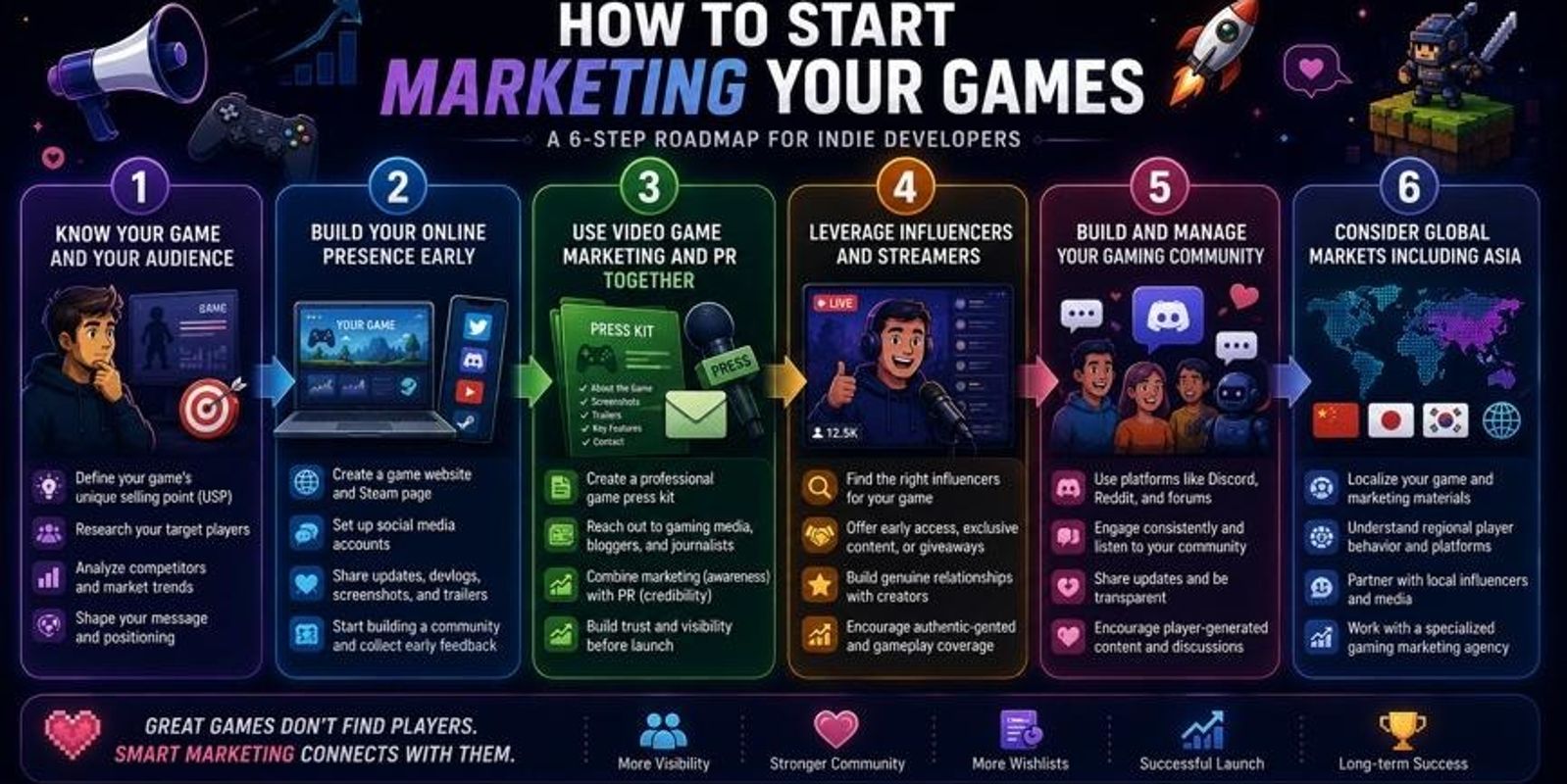
Step 1: Know Your Game and Your Audience
Defining Your Game's Unique Selling Point
Before creating content or reaching out to media, answer one critical question:
Why should someone play your game instead of another?
Your Unique Selling Point (USP) is the feature, mechanic, story, art style, or experience that differentiates your game.
Examples include:
- A unique combat system
- A distinctive visual style
- A compelling narrative
- Innovative multiplayer features
- A novel gameplay loop
Your USP becomes the foundation of every trailer, Steam page description, press release, influencer pitch, and social media post.
Researching Your Target Player
Not every gamer is your audience.
Research:
- Age demographics
- Preferred platforms
- Gaming interests
- Geographic markets
- Community behaviors
- Content consumption habits
Study communities surrounding similar games on Reddit, Discord, Steam forums, YouTube, and Twitch.
The more specific your understanding of players, the more effective your marketing becomes.
Step 2: Build Your Online Presence Early
Creating a Game Website and Steam Page
Not every gamer is your audience.
Research:
- Age demographics
- Preferred platforms
- Gaming interests
- Geographic markets
- Community behaviors
- Content consumption habits
Study communities surrounding similar games on Reddit, Discord, Steam forums, YouTube, and Twitch.
The more specific your understanding of players, the more effective your marketing becomes.
Setting Up Social Media Accounts
Social media is one of the most effective ways to share development progress and build visibility.
Popular platforms include: X (Twitter), TikTok, Instagram, YouTube, LinkedIn, Reddit, etc.
Each platform serves a different purpose.
TikTok drives discovery.
YouTube supports long-form storytelling.
Discord strengthens community engagement.
Reddit encourages discussion and feedback.
LinkedIn helps connect with publishers, partners, and industry professionals.
Starting a Gaming Community Early
One of the most overlooked aspects of marketing is community building.
Building a community early allows you to:
- Collect feedback
- Test ideas
- Improve retention
- Create advocates
- Generate word-of-mouth marketing
Players who follow your project months before launch are often your first customers, ambassadors, and content creators.
Step 3: Use Video Game Marketing and PR Together
Writing a Game Press Kit
A professional press kit makes it easier for media outlets and creators to cover your game.
Include:
- Game overview
- Key features
- Screenshots
- Logos
- Trailer links
- Team information
- Contact details
A well-organized press kit increases your chances of earning media coverage.
Reaching Out to Gaming Media and Journalists
Media outreach remains a valuable part of game promotion.
Focus on:
- Relevant gaming publications
- Indie-focused websites
- Genre-specific outlets
- Content creators
- Industry newsletters
Personalized outreach consistently performs better than mass email campaigns.
What Is Video Game Marketing and PR and Why You Need Both
Many developers ask: what is video game marketing and PR?
Although they work together, they serve different purposes.
Marketing focuses on generating awareness and attracting players through channels such as social media, advertising, content creation, and influencer partnerships.
PR focuses on building credibility through media coverage, interviews, reviews, and community reputation.
The most successful launches combine both functions. Marketing creates visibility, while PR builds trust.
This is why modern video game marketing and PR should be viewed as complementary rather than separate disciplines.
Step 4: Leverage Influencers and Streamers
How to Find the Right Influencers for Your Game
Bigger isn't always better.
The most effective creator partnerships are usually based on audience fit rather than follower count.
Look for creators who:
- Play similar games
- Have engaged communities
- Match your target demographic
- Create authentic content
A mid-sized creator with a highly relevant audience can often outperform a celebrity streamer for indie titles.
What to Offer Influencers as an Indie Developer
You do not always need a large budget.
Consider offering:
- Early access
- Exclusive content
- Developer interviews
- Community giveaways
- Behind-the-scenes access
Many creators value unique experiences that help them produce interesting content for their audiences.
Step 5: Build and Manage Your Gaming Community
Discord, Reddit, and Forums
Community platforms help transform interested players into loyal fans.
Popular channels include:
- Discord
- Steam Community Hub
- IndieDB
- Game Jolt
- Official forums
These spaces allow developers to gather feedback, answer questions, encourage user-generated content, and maintain ongoing conversations.
Gaming Community Management Best Practices
Effective gaming community management requires more than posting announcements.
Best practices include:
- Responding consistently
- Listening to feedback
- Encouraging discussion
- Rewarding participation
- Maintaining transparency
Strong communities often become a game's most powerful marketing asset.
Step 6: Consider Global Markets Including Asia
How to Get into Video Game Marketing in Asian Markets
Many indie developers focus primarily on North America and Europe, but Asia represents one of the largest gaming markets in the world.
Entering Asian markets often requires: localization, regional social media strategies, cultural adaptation, local influencer partnerships
According to the 2025 China Game Industry Report, China's gaming market generated more than RMB 325 billion in annual revenue, making it one of the largest gaming markets in the world.
Key platforms include:
- Bilibili
- Douyin
- Xiaohongshu
- Huya
- DouYu
Successful localization involves adapting messaging, creator partnerships, content formats, and community strategies—not simply translating text.
Working With a Specialized Gaming Marketing Agency
International expansion introduces new challenges:
- Language barriers
- Platform differences
- Cultural expectations
- Influencer ecosystems
- Media relationships
Many developers choose to work with specialized gaming marketing agencies when entering new regions.
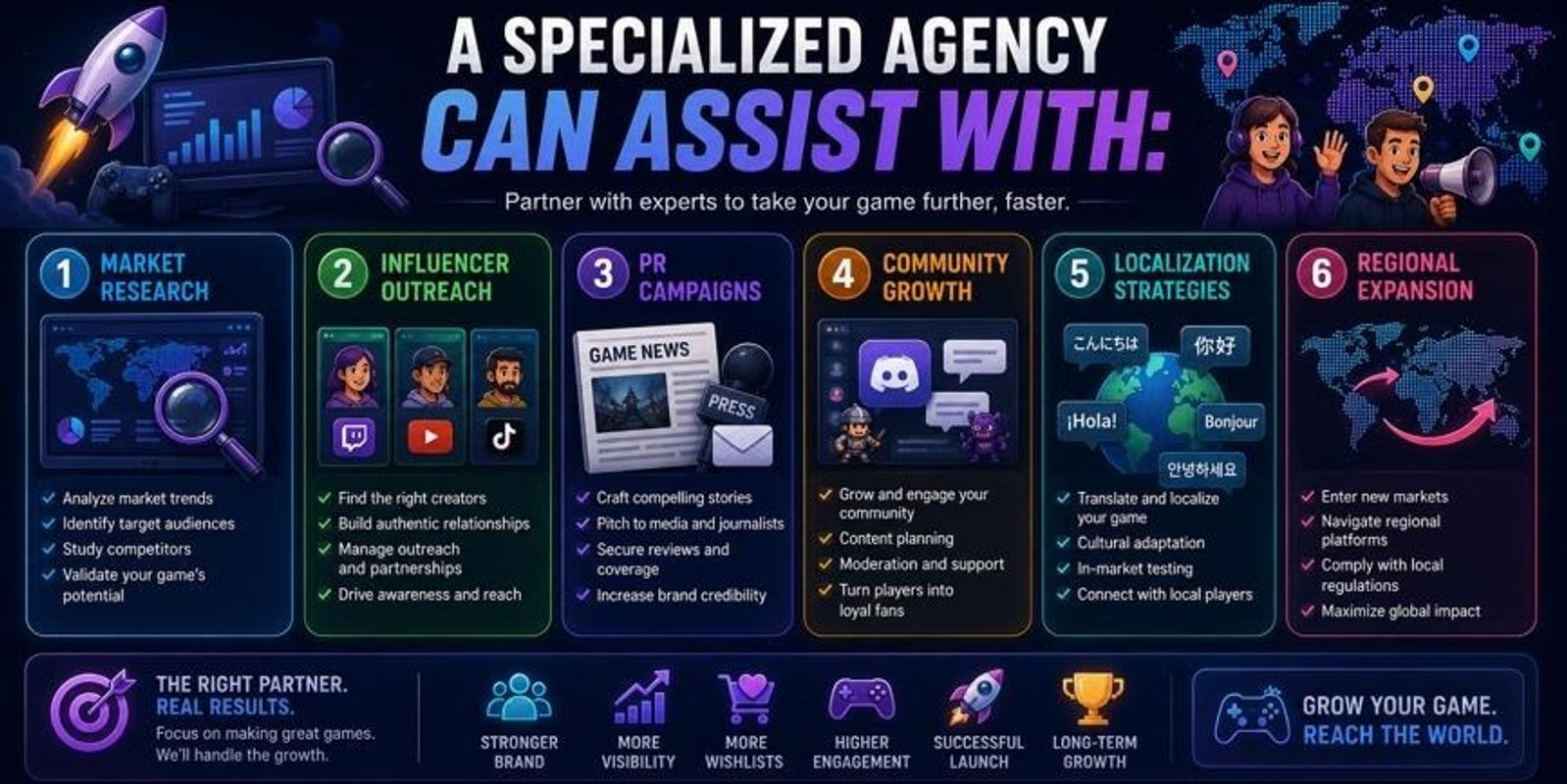
- Market research
- Influencer outreach
- PR campaigns
- Community growth
- Localization strategies
- Regional expansion
The right partner can help developers navigate unfamiliar markets and maximize campaign effectiveness.
Using AI to Support Game Marketing
Many indie developers now use AI-powered tools to assist with:
- Content planning
- Localization drafts
- Audience research
- Community sentiment analysis
- Marketing ideation
AI can improve efficiency, but it should support marketing efforts—not replace authentic player engagement and relationship building.
Conclusion: Your Game Deserves to Be Found
Learning how to market your video game is one of the most valuable investments an indie developer can make.
Successful launches rarely rely on a single tactic. Instead, they combine:
- Early audience building
- Steam wishlist growth
- Video game marketing and PR
- Influencer partnerships
- Gaming community management
- Regional expansion strategies
- Consistent player engagement
The most successful games are not always the ones with the largest budgets. They are often the games that begin building an audience early and maintain meaningful relationships with players throughout development.
At Asia Game Buzz, we've found that discoverability is no longer just about advertising. It's about creating trust with players, creators, journalists, and communities long before launch day arrives.
Your game deserves to be discovered. Start early, stay consistent, and focus on building genuine connections. The stronger your community becomes before launch, the greater your chances of long-term success.