
How to Promote a Video Game Idea: A Complete Guide
You have a game idea. Maybe there's already a prototype, a Steam page or even a release date. The next question is usually much harder: how do you get people to care about it?
That is really what learning how to promote a video game idea comes down to.
Getting noticed is becoming a bigger part of the job. GDC's 2026 State of the Game Industry, based on responses from more than 2,300 industry professionals, shows just how fragmented game discovery has become. Among the marketers surveyed, social media was the most-used discovery method at 65%, followed by streamers at 39%, paid advertising at 31% and events at 30%.
The good news is that promotion doesn't have to start with a huge advertising budget. A memorable name, a pitch people understand immediately, good gameplay footage and a small but active community can give you a much stronger starting point.
What Does It Mean to Promote a Video Game Idea?
Game promotion begins earlier than many developers think.
You don't need to wait until the game is finished. Once you have something worth showing—a prototype, gameplay footage, concept art or a strong demo—you can start finding out whether the idea connects with players.
At this stage, promotion is also a form of validation. Can people understand what the game is about right away? Which feature gets the biggest reaction? What other games do they compare it to? After 20 seconds of gameplay, would they actually want to see more?
Those reactions can shape your marketing long before release.
How to Prepare Your Video Game for Promotion
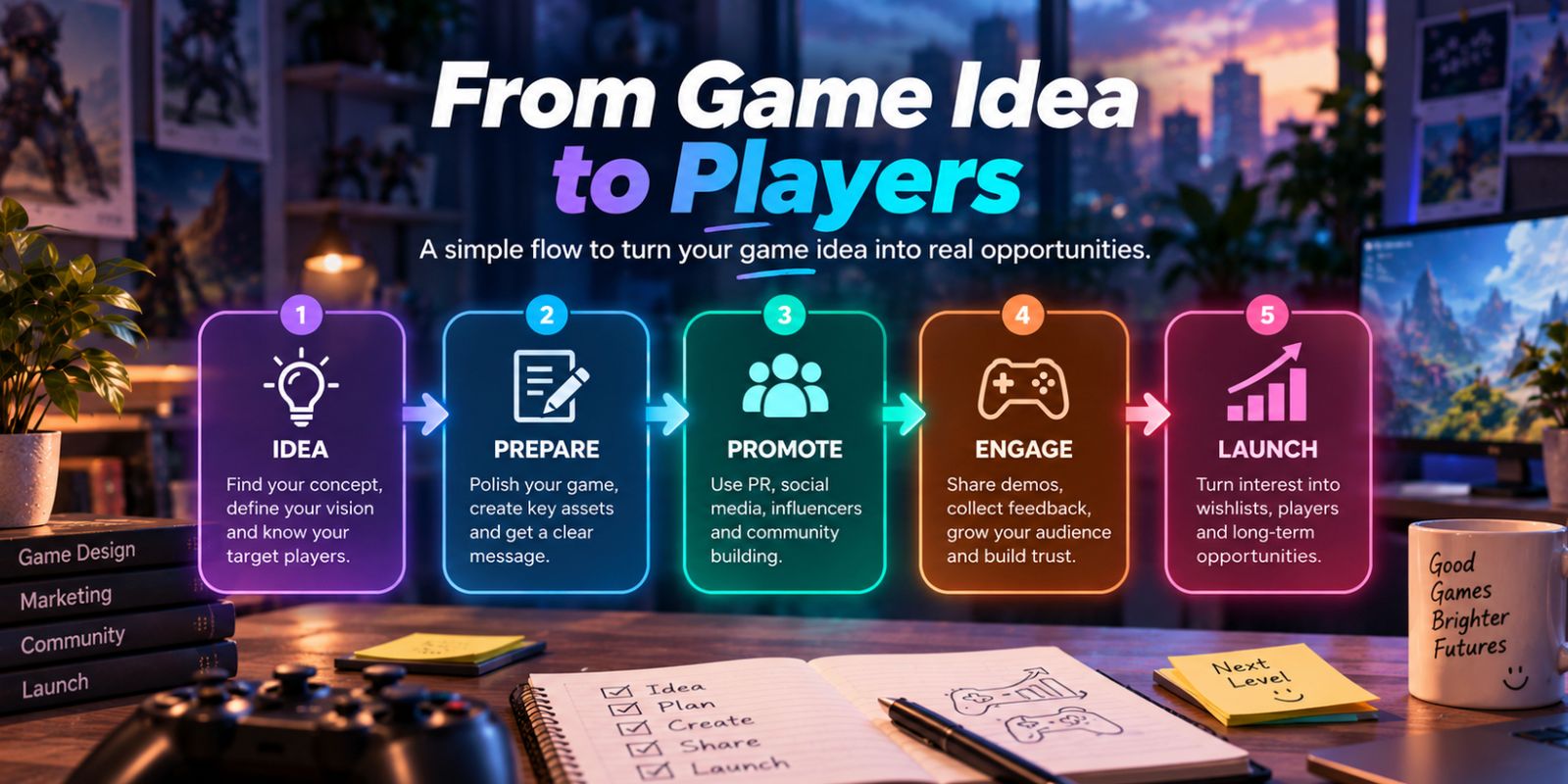
Before reaching out to journalists or creators, try to explain your game in one or two sentences.
If that takes five minutes, the positioning probably needs more work.
Players should quickly understand the genre, what they actually do and what makes the experience interesting. “A multiplayer survival game” tells us very little. “A co-op survival game where your base moves every night” immediately gives people something to picture.
Then give them something visual. Even early gameplay footage can communicate more than pages of description.
At minimum, prepare a short description, screenshots, gameplay clips, key art and somewhere to send interested players—usually a website, Steam page or community.
How to Name a Video Game
Developers can spend months thinking about mechanics and surprisingly little time thinking about the title.
When considering how to name a video game, ask one practical question: If someone hears the name once, can they find the game again tomorrow?
A title doesn't need to explain the entire game, but it should be memorable and distinguishable.
Search the proposed name on Google, Steam, YouTube and social platforms. If the results are already dominated by another game, company or common phrase, building search visibility around it may be unnecessarily difficult.
Think internationally too. A title that sounds great in English might be difficult to pronounce or transliterate—or carry an unintended meaning elsewhere.
If China, Japan or Korea matters to your launch, naming and localization are worth considering early rather than a few weeks before release. And before investing heavily in branding, check relevant domains and trademarks.
How to Create a Strong Game Pitch
Imagine meeting a journalist or creator at Gamescom and having about 20 seconds to explain your game.
What would you say?
That's a useful test for your pitch.
A simple structure is:
[Game title] is a [genre] where players [core experience], with [the thing that makes it different].
Don't get too attached to a formula, though. Sometimes the hook is an unusual mechanic. Sometimes it's the setting, art direction or an unexpected combination of genres.
More importantly, don't send the same pitch to everyone.
A publisher wants to understand commercial potential. A journalist wants to know why the game is worth covering now. A streamer wants to know whether it will make entertaining content. Players simply want to know whether they'll enjoy it.
Same game. Different reason to care.
How to Build a Marketing Strategy for Your Video Game
One of the easiest ways to waste a marketing budget is to choose channels before deciding who the game is actually for.
Instead of starting with “we need TikTok, Discord, influencers and PR,” start with the player.
Where do fans of similar games discover new titles? Which creators do they watch? Which communities are they part of? What would make them stop scrolling when they see your gameplay?
Then think about the journey:
See the game → Get interested → Watch/learn more → Wishlist or play the demo → Buy → Stay involved
Not every piece of content has to sell the game immediately. A funny gameplay clip can create discovery. A developer video can explain the concept. A streamer can show what playing actually feels like. Your store page then gives interested players somewhere to go.
Paid acquisition is getting more competitive too. AppsFlyer's State of Gaming for Marketers 2026, based on 24.8 billion installs across 9,600 games, found that gaming companies spent approximately $25 billion on user acquisition in 2025, up 3.8% year over year. Ad impressions rose 20%.
For smaller studios, that's another reason to find out what players respond to before spending heavily.
Video Game Public Relations: What You Need to Know
Video game public relations is sometimes treated as “send a press release and hope a big gaming site writes about it.”
Good game PR is much more targeted.
It's about finding the story around your game and matching that story with journalists, publications and communities that might genuinely care.
Maybe you have striking art direction. Perhaps your demo suddenly takes off during Steam Next Fest. Maybe the development team has an unusual story, or you're bringing a successful Asian title to Western markets.
Those are stories. “Our game launches next month” by itself may not be.
How Video Game PR Helps Build Awareness
PR gives your game visibility outside your own channels.
You can tell players your game is interesting. A journalist choosing to interview the developer, preview the demo or write about an unusual mechanic gives them another reason to look.
PR also works better when connected to everything else you're doing. A trailer can become the reason for media outreach. Preview keys can go to journalists and creators around the same period. Social posts can amplify the resulting articles and videos.
Think of PR as part of the launch conversation, not another box to tick.
Build a Game Website and Landing Page
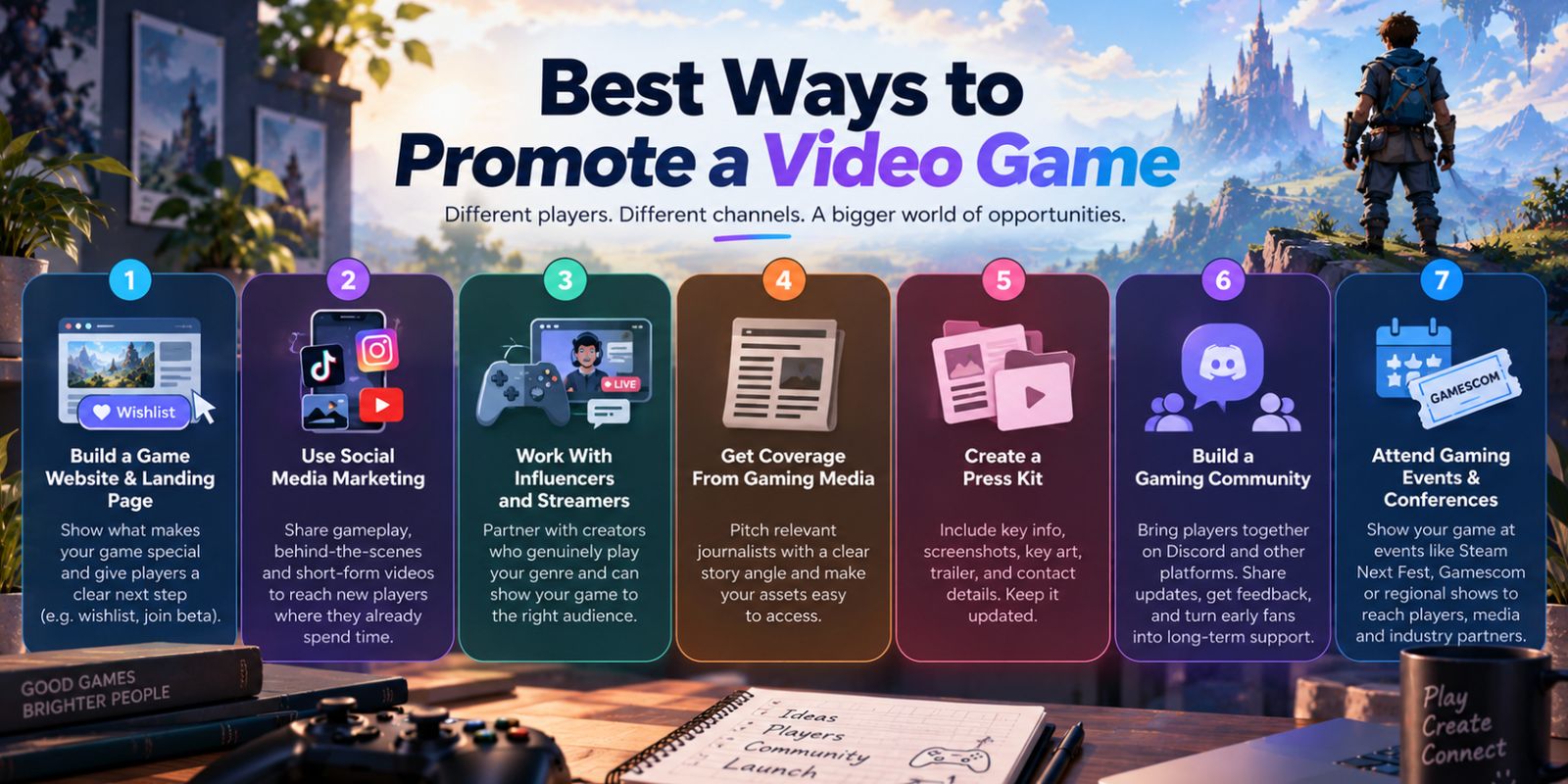
Don't overcomplicate it. Visitors should quickly understand what the game looks like, why it's interesting and what they should do next.
For a PC launch, that might simply be “Wishlist on Steam.” Before a playtest, it could be “Join the Beta.”
One strong call to action is better than six competing ones.
Use Social Media Marketing
Game development naturally produces content. Show an interesting mechanic. Post an unexpected bug. Compare an old build with the current one. Introduce a character. Show how an environment was created.
Short-form video is particularly relevant in 2026. Among the 102 marketers surveyed by GDC, 65% used social media as a leading discovery method. Their most-used social platforms were Instagram/Reels (66%), TikTok (64%) and YouTube/Shorts (63%).
That doesn't mean your game needs to be everywhere. Pick the places where your likely players already spend time and create formats your team can realistically maintain.
Work With Gaming Influencers and Streamers
Don't begin with follower count.
A creator with 30,000 followers who regularly plays games like yours may be more useful than a general gaming account with one million followers.
Look at recent views, audience interaction, genre fit, geography and how the creator actually presents games. GDC's 2026 survey also found that 39% of the marketers surveyed used streamers as a discovery method, reinforcing their role alongside social media and paid advertising.
Get Coverage From Gaming Media
Don't build a list of hundreds of gaming websites and send everyone the same email.
Look for journalists who have recently covered your genre, comparable games or the subject behind your title. Then give them a reason why this particular story fits their coverage.
And make their job easy. Screenshots, trailers, release information and contact details should all be readily accessible.
Create a Press Kit
Your press kit doesn't need to be fancy.
Include the game description, key features, platforms, release information, screenshots, key art, trailer, developer background and contact information.
Most importantly, keep it current. A press kit still showing last year's release window creates unnecessary confusion.
Build a Gaming Community
A Discord server with 300 people who genuinely care about the game can be more useful than a social account with thousands of passive followers.
Give early players reasons to participate: playtests, development updates, feedback sessions, polls, Q&As or sneak peeks.
Listen to how they describe the game too. Players sometimes explain what makes a game fun more clearly than its official marketing copy does.
Attend Gaming Events and Conferences
Events can be valuable, but bigger isn't automatically better.
Steam Next Fest can put a playable demo in front of PC players. Gamescom can serve consumer, media and business goals. GDC is industry-focused, while Tokyo Game Show and ChinaJoy can make sense for developers targeting Asian markets.
Choose events because the right audience will be there—not simply because everyone else is attending.
What's Working for Game Discovery in 2026?
There isn't one dominant discovery channel anymore.
GDC's 2026 marketing sample shows the mix clearly: social media (65%), streamers (39%), paid advertising (31%), events (30%), real-time communities such as Discord (28%), and traditional press and bloggers (25%).
For Steam developers, there's another useful distinction. Wishlists are important, but Valve says that—with exceptions such as Popular Upcoming—wishlist totals aren't generally a direct factor in Steam's algorithmic visibility. Tags, player interest, purchases and actual engagement with the game all play roles in how Steam understands and surfaces titles.
So don't treat hitting a particular wishlist number as the entire marketing strategy. The bigger job is creating enough genuine player interest that people want to follow, play, buy and talk about the game.
AI Is Changing Game Marketing Workflows
AI is also becoming part of everyday game-industry workflows.
GDC's 2026 research found that 36% of game-industry professionals were using generative AI at work, rising to 58% among respondents at publishers, support teams and marketing or PR firms. Research and brainstorming were the most common use cases.
For marketing teams, AI can help with research, brainstorming and creative variations. But producing more content doesn't automatically make it better. AppsFlyer's 2026 research found top gaming advertisers were already producing roughly 2,400–2,600 creative variations per quarter, 25–30% more than a year earlier.
The useful question is no longer simply “How can we create more?” It's “Which idea is actually worth creating more versions of?”
When Should You Hire a Video Game PR Agency?
Not every indie game needs a video game PR agency.
If you're still experimenting with the concept and have very little to show, agency support may be premature. You can start building a community, testing content and talking to smaller creators yourself.
An agency becomes more useful when there's something meaningful to amplify: a reveal, publisher announcement, demo, crowdfunding campaign, major update, event appearance or launch.
Capacity matters too. Launch periods can quickly stretch a small internal team when press outreach, review codes, creators, events and social campaigns all need attention at once.
How to Choose the Right Video Game PR Agency
Ask agencies about games similar to yours—not simply their biggest clients.
Who did they pitch? Which markets did they cover? What kind of results did the campaign produce? Who will actually work on your account?
If you're launching internationally, regional knowledge becomes particularly important. A media and creator strategy that works in the U.S. can't simply be copied into China, Japan or Southeast Asia.
And be cautious about unrealistic promises. A video game PR agency can create opportunities and build media relationships, but it cannot guarantee editorial coverage or positive reviews.
Video Game PR vs Traditional Game Marketing
Video Game PR
Game Marketing
Focus
Story and reputation
Reach and conversion
Typical channels
Media, interviews, reviews
Social, ads, creators, storefronts
Exposure
Mainly earned
Paid, owned and earned
Common measures
Coverage, mentions, sentiment
Wishlists, installs, sales, ROAS
In practice, separating them completely isn't very useful. A strong launch usually needs both.
How Much Does Video Game Public Relations Cost?
There isn't one meaningful price.
A small indie developer might hire a freelancer for a single announcement. Another studio might work with a video game PR agency for several months around launch. International publishers may need PR, creator and localization support across multiple markets.
Ask what's actually included: strategy, media pitching, press materials, review management, events, influencer outreach, reporting and regional support.
The cheapest proposal isn't necessarily the best value, and the most expensive agency isn't automatically the right fit.
Common Video Game Promotion Mistakes to Avoid
Starting marketing two weeks before release is an obvious mistake, but there are others.
Don't describe your audience simply as “gamers.” Don't send identical pitches to every journalist. Don't choose influencers because their follower numbers look impressive. And don't spend heavily on ads before learning which creative ideas actually get a response.
Most importantly, don't hide the game for too long.
Developers sometimes wait for everything to look perfect before showing anything. By then, they've lost months of opportunities to learn which mechanics, characters or ideas players actually find interesting.
Frequently Asked Questions
How Do I Get People Interested in My Game Idea?
Give them something interesting to see. A short gameplay clip showing one distinctive mechanic can communicate more than several paragraphs explaining the concept. Test different hooks and pay attention to what players naturally comment on and share.
How Do I Get Media Coverage for My Video Game?
Find journalists who already cover games like yours and contact them when you have something genuinely worth discussing—a reveal, demo, release date, unusual development story, milestone or distinctive gameplay feature. Keep the pitch brief and make your assets easy to access.
Do I Need a Video Game PR Agency?
Not always. Early-stage developers can often handle community building and smaller-scale outreach themselves. A video game PR agency becomes more useful around a major announcement or launch, especially when you need established media relationships, regional expertise or additional campaign capacity.
Final Thoughts
There isn't one secret to how to promote a video game idea. It comes down to getting a series of smaller things right: learning how to name a video game so people remember it, developing a pitch they understand, showing gameplay worth watching, finding creators who fit the audience, earning relevant media attention and building a community that has a reason to stay involved.
The 2026 data reinforces that point. Game discovery now happens across social video, streamers, paid media, communities, events, storefronts and traditional gaming press. The strongest strategy isn't necessarily being everywhere it's understanding where your players discover games and giving them something worth noticing there.
When a game enters new markets, localization also goes beyond translating a Steam page. Asia Game Buzz supports developers and publishers with video game public relations, gaming media outreach, localized content and influencer/KOL campaigns across Asian markets, helping international teams connect with relevant players, creators and gaming media.