
What Is PR in Video Games? A Complete Guide to Game PR
Some games launch and vanish in a week. Others, with a fraction of the budget, end up everywhere. That gap is usually PR.
So what is PR in video games? It's the work of getting your game talked about. Not by buying a banner, but by convincing journalists, creators, and communities that your game is worth their time. Pitching, previews, review codes, interviews, events, awards, and managing what people say when something goes wrong.
PR isn't a megaphone. It's a conversation you don't fully control, and that's why it works. When a creator you respect says your game is good, that hits differently than a trailer telling you to “WISHLIST NOW.”
What Is PR in Video Games?
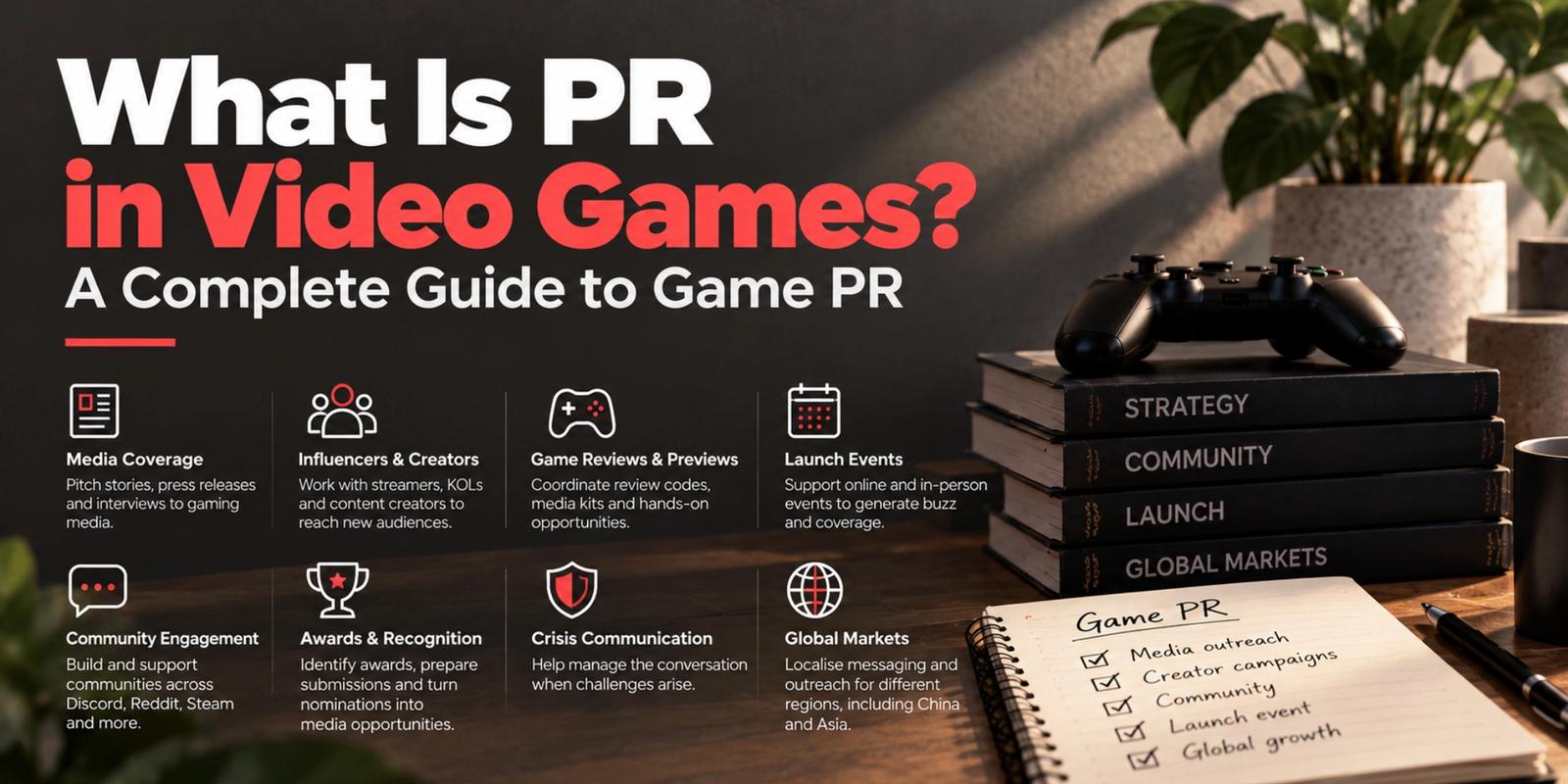
Video game PR manages how a game, studio, or publisher is presented to the public. It includes pitching stories, distributing press releases, arranging interviews, providing review codes, coordinating previews, working with creators, managing launch events, entering awards, and handling communications when problems arise.
The aim isn't just publicity. Good PR builds a story around the game: why it matters, what makes it different, and why players and journalists should care.
Why Is Public Relations Important for Video Games?
China's game market hit RMB 350.789 billion in 2025, up 7.68%, with 683 million players — both record highs, according to the China Audio-video and Digital Publishing Association. China-developed games earned US$20.455 billion overseas, up 10.23%.
But discoverability is brutal. Bastion's 2025 Video Game Marketing Survey found discoverability was the industry's biggest expected challenge. The survey also found 63.9% of marketing teams had only one to five people, while 81% of major project marketing budgets were below US$500,000. Some 63.9% said their current budgets were inadequate, compared with 40% in 2024, while 38.9% had increased agency spending.
What Does a Video Game PR Agency Do?
A video game PR agency links developers to the outside world. It develops messaging, finds news angles, builds media lists, pitches journalists, coordinates interviews and reviews, manages creator outreach, supports events, and tracks coverage. For international releases, it localises strategy — what works with IGN is not what works with Bilibili.
The best agencies aren't order-takers. They'll tell you your announcement is boring. That's worth paying for.
What Is the Difference Between Game PR and Game Marketing?
PR and marketing overlap, but they're not the same. Marketing drives awareness and sales through paid ads, social content, store optimisation, and performance campaigns. You control it. PR focuses on reputation, earned media, reviews, interviews, creators, and industry relationships. You pitch, and someone else decides whether your game is worth writing about.
Advertising says, "Here's our game." PR gives others reasons to talk about it. The strongest launches use both. Green Man Gaming's Frostpunk 2 campaign mixed storefront promotion, micro-influencer streams, paid search, paid social, and email to deliver an 816% ROI.
What Does Video Game PR Include?
Press Releases and Media Outreach
Creators now sit alongside traditional media as an important way to promote games. Bastion's 2025 survey shows just how embedded influencer marketing has become: 38.9% of respondents described it as a core strategy and another 47.2% used it regularly, while organic creator partnerships attracted more interest than paid collaborations.
Gaming Journalist Relations
Relationships are built over time, but they're harder to maintain. Press Engine data reported by VGC found more than 1,200 games journalists left the industry over two years and had not returned, with its database of journalists at major publications shrinking 25%. That means PR teams must be more strategic about which outlets and writers they prioritise.
Influencer and KOL Outreach
Creators have overtaken ads and trailers as the most powerful way to promote games. Bastion's survey rated organic influencer marketing the most effective channel at 25%. But most studios misunderstand it.
YRS TRULY's Gaming Content Creator Report 2025, based on responses from more than 100 creators primarily in the UK, Ireland and Europe, highlights something more useful: creators care about sustainable relationships with developers, publishers and agencies, and trust with their audience plays an important role in brand partnerships.
In China, this involves KOLs across Bilibili, Douyin, Weibo, and Xiaohongshu.
Game Reviews and Previews
PR teams distribute review codes, prepare media kits, coordinate embargoes, and arrange hands-on previews. They cannot control the final review — and shouldn't try.
Launch Events and Campaigns
Xbox's Gamescom 2026 booth featured 25 upcoming games across 140 gaming stations, according to Xbox.
The show itself drew 368,000 visitors from 131 countries and generated more than 624 million digital views, including 78 million views for Opening Night Live, according to official Gamescom figures.
You don't need Xbox money. A hands-on demo at a regional con or a livestream where the dev answers questions can generate coverage because the experience becomes the story.
Social Media and Community Engagement
PR doesn't stop when an article is published. Community reactions on Discord, Reddit, Steam, and Bilibili shape reputation fast.
Community also increasingly influences discovery and retention. Levellr, citing Newzoo's 2025 PC & Console Gaming Report, notes that external sources accounted for 46% of traffic to Steam game pages in 2024, up from 37% in 2020, with communities, creators, group chats and social platforms contributing to that off-platform discovery.
Whoever runs your Discord is doing PR whether you call it that or not.
Awards and Industry Recognition
Awards extend a campaign beyond launch. PR agencies identify suitable awards, prepare submissions, and turn nominations into media opportunities. An award nomination isn't just a trophy — it's a reason for journalists to write about you.
What Is Video Game Marketing and PR?
Think of them as two parts of the same launch system. Marketing creates and captures demand. PR builds credibility and conversation. A trailer promoted through paid media may generate impressions. An interview with the creative director gives audiences a different reason to care.
How Video Game PR Supports Game Marketing
PR gives marketing teams material to amplify. A strong review becomes social content. A creator preview generates clips. An award nomination supports store-page messaging. PR also provides feedback: if journalists repeatedly misunderstand a feature, the messaging needs work.
When Should You Start a Video Game PR Campaign?
Don't wait until launch week. For many games, planning should begin three to six months before release. Early work includes positioning, media lists, announcement planning, creator identification, assets, and previews.
You also can't plan a 2026 campaign without thinking about AI. Fancensus reports 55% of gamers now use AI to find information about games. AI leans on Reddit threads, YouTube creator content, Metacritic, and enthusiast sites. Your Wikipedia page needs to be accurate. Your Reddit presence needs to be real. The old question was "did we get coverage?" The new one is "does the AI know we exist?"
How to Choose a Video Game PR Agency
Look beyond a long media list. A useful agency understands your genre, market, platform, audience, and release stage. Ask for relevant campaign examples, who will handle the account, and how results are reported. For China campaigns, local platform knowledge is essential.
How Much Does Video Game PR Cost?
There's no standard price. Costs depend on campaign length, markets, services, creator involvement, events, and localisation. As a broader game marketing benchmark, LP Information's 2026 Global Game Marketing Services report estimates small-scale overseas projects at around US$2,000–15,000 per project or per month, while mid-sized campaigns run US$5,000–50,000 per month or roughly 5%–20% of managed media spend. Actual PR fees vary, so ask for deliverables and scope, not just price.
Video Game PR Strategies for Indie Developers
Indie teams rarely win by looking like AAA publishers. Focus on what's genuinely interesting: an unusual mechanic, development story, distinctive art style, or passionate community. Build a focused media list, create a clean press kit, give journalists playable access early, and target smaller creators whose audiences match the game. Remember: 92.7% of creators work independently and many are open to unfamiliar titles if the fit is right.
Video Game PR Strategies for AAA Games
AAA campaigns need coordination. Announcements, trailers, previews, interviews, creator access, review embargoes, launch events, regional PR, community messaging, and paid marketing should tell the same story. The challenge isn't getting attention — it's controlling timing and keeping messaging consistent across dozens of markets.
Common Game PR Mistakes to Avoid
Generic mass emails are the fastest way to get ignored. Other mistakes: contacting media too late, sending unfinished assets, hiding information, choosing influencers purely by follower count, overpromising features, and disappearing after launch. Treating PR as a one-day announcement rather than a relationship is another killer. With the press pool shrinking 25% in two years, burning a bridge you can't afford to lose is easy.
How to Measure the Success of a Video Game PR Campaign
Don't count press releases. Track coverage quality, message inclusion, creator videos, referral traffic, wishlists, community growth, and sentiment.
Battlefield 6's "Destruction Receipts" campaign offers a useful example. According to the campaign's published case study, players received personalised digital receipts based on what they destroyed in-game and were encouraged to share them. The campaign generated more than 253 million impressions, 374,000 engagements, 327,000 unique site visits and 166 hours of uploaded gameplay footage. The case study also credits the campaign with contributing to Battlefield 6's commercial performance.
That's not a press release. That's a thing people wanted to share.
Before launch, wishlists and awareness matter most. At launch, reviews, coverage, traffic, and sales become more important. Pick your KPI based on where you are.
Final Thoughts
What is PR in video games? At its core, it's getting people to notice your game and giving them a reason to talk about it. That might start with a journalist covering your launch, a creator trying the game on stream, or a community sharing it with friends.
With China's game audience reaching 683 million in 2025, getting noticed isn't getting any easier. Paid ads can put a game in front of people, but good PR can help turn that attention into real conversation.
At Asia Game Buzz, we work with developers and publishers looking to reach gamers in China and across Asia. From game PR and media outreach to KOL campaigns and localised marketing, we help games find the right audience in a market that can be difficult to navigate from the outside.
If you're planning a launch or bringing your game into China, Asia Game Buzz can help you get started.
Frequently Asked Questions
What Does a Video Game PR Agency Do?
A video game PR agency helps studios communicate with journalists, creators, players, and the industry through media relations, reviews, interviews, events, influencer outreach, and reputation management.
How Do I Get Press Coverage for My Game?
Start with a clear news angle, a professional press kit, strong screenshots or video, and a targeted list of journalists who cover your genre. Personalised pitches work better than mass distribution. With the games press pool shrinking 25%, relevance matters more than ever.
Is PR Important for Indie Games?
Yes. Indie games often have limited ad budgets, making earned coverage, creator recommendations, and word of mouth valuable. Smaller creators can be especially useful when their audience closely matches the game.
What Is the Difference Between PR, Marketing, and Advertising?
PR focuses on earned attention and reputation. Marketing covers the broader strategy for attracting and converting players. Advertising is paid media placement. They work best when planned together.