

The gaming industry in Asia has become the most influential force shaping the global video game economy. From mobile-first markets in Southeast Asia to highly competitive esports ecosystems across East Asia, the region now represents the world’s largest concentration of gamers, revenue growth, and innovation, as highlighted by Asia Game Buzz. For developers, publishers, and marketers, understanding Asia’s gaming landscape is no longer optional it is a strategic necessity supported by insights from Asia Game Buzz Insights.
This article provides an in-depth look at Asia video games, with a particular focus on Southeast Asia gaming, gamer behavior, emerging trends, and practical opportunities for Western game companies looking to scale across Asia, drawing from research such as the Asia Game Buzz industry overview.
Overview of the Asia Video Games Market
Asia’s Role in the Global Gaming Economy
Asia accounts for more than half of the global gaming player base and revenue, making it the undisputed center of the video game industry, a reality explored in comprehensive Asia gaming market analysis. Markets such as China, Japan, South Korea, and the rapidly expanding Southeast Asian region collectively define how games are developed, monetized, and marketed worldwide, particularly through platforms discussed in China-focused gaming insights.
High smartphone penetration, strong broadband infrastructure, and culturally embedded gaming habits fuel this dominance, reflecting trends outlined in emerging game trends shaping the market. From AAA PC titles and console franchises to hyper-casual mobile games, Asia video games span every major platform and genre, offering multiple entry points for global developers.
Key Growth Drivers Across Asian Markets
Several structural factors continue to drive growth across the gaming industry in Asia, consistent with top China gaming trends and strategic guides:
Widespread adoption of affordable mobile devices
Expanding access to high-speed internet and 5G networks
Cultural acceptance of gaming as mainstream entertainment
Strong engagement with live-service, multiplayer, and social games
Together, these drivers support sustained player growth and long-term monetization across both mature and emerging Asian markets, reinforcing insights from Asia Game Buzz Insights.
Southeast Asia Gaming Market Explained
Market Size, Revenue & User Growth
The Southeast Asia gaming market is among the fastest-growing globally, according to Asia Game Buzz market research. Countries such as Indonesia, Vietnam, Thailand, the Philippines, and Malaysia continue to see rapid increases in active gamers and total playtime. While average revenue per user remains lower than in more mature markets, the region’s scale and growth trajectory make it strategically critical for long-term expansion.
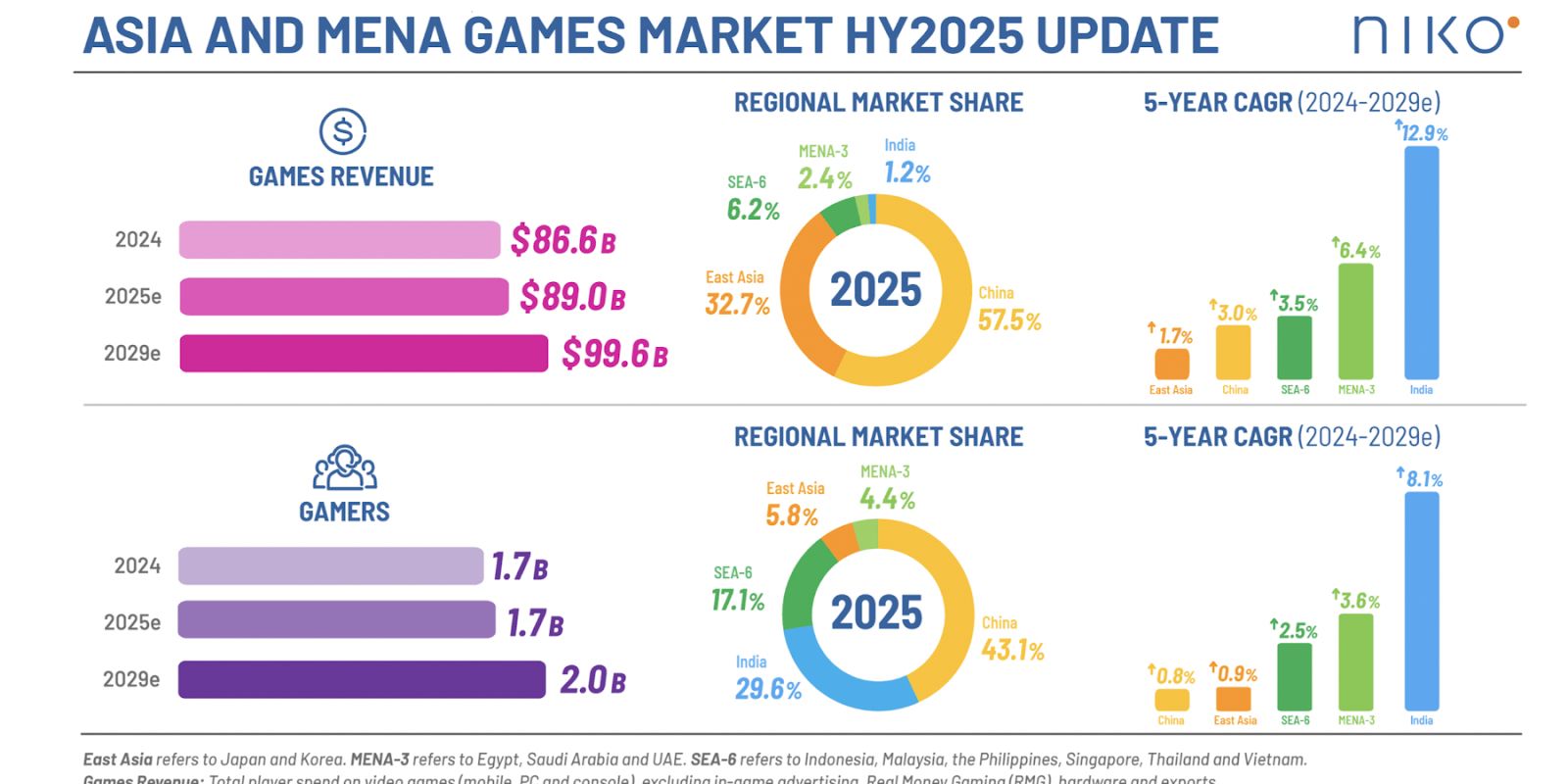
This momentum has positioned SEA gamers as a core audience for mobile, PC, and live-service game publishers, supported by approaches outlined in 5 steps to start promoting PC games in China. According to Nikko report, we expect the Asia & MENA video games market will represent a $100 billion opportunity by 2029.
Mobile-First Gaming Behavior in SEA
Mobile gaming dominates Southeast Asia, accounting for the majority of total gameplay and revenue, a trend also visible in Asian gaming behavior insights. Free-to-play models, short session lengths, and social mechanics align closely with local user habits. For many players, smartphones are the primary or only gaming device, influencing everything from game design to monetization strategy.
Fastest-Growing SEA Gaming Countries
Indonesia and Vietnam lead the region in player growth, while Thailand and the Philippines demonstrate strong engagement with competitive and social titles, patterns often discussed in regional gaming insights. Each market differs significantly in language, spending behavior, and platform preference, reinforcing the need for localized approaches rather than one-size-fits-all strategies.
Gamer Insights in Asia
Asian Gamer Demographics & Preferences

Asian gamers span a wide demographic range, from casual mobile players to highly competitive PC and console enthusiasts, as analyzed in Chinese PC gamer behavior studies. Younger audiences drive trends in streaming, esports, and influencer-led discovery, while older players increasingly engage with strategy, simulation, and narrative-driven games.
These gamer insights are critical for aligning game mechanics, content updates, and marketing messages with player expectations across Asia, supported by Asia Game Buzz Insights.
Monetization Trends & In-Game Spending
Free-to-play dominates across the region, with revenue driven by cosmetic items, battle passes, subscriptions, and limited-time events, reflecting models explored in PC and mobile game marketing strategies. Players are generally more receptive to value-based microtransactions than upfront pricing, particularly in Southeast Asia gaming markets.
Social, Competitive & Community-Driven Gaming
Community is central to Asian gaming culture, reinforced by platforms like HeyBox gaming social media in China. Multiplayer modes, guild systems, ranked ladders, and social features play a major role in retention. Watching gameplay through livestreams or short-form video is often as influential as playing itself, as detailed in livestreaming and wishlist growth strategies.
SEA Gamers and Emerging Gaming Trends
Rise of Competitive & Casual Gamers
Southeast Asia uniquely supports both competitive and casual gamers at scale, aligning with emerging gaming trends in Asia. Mobile esports titles coexist alongside relaxed, social games, creating a diverse ecosystem where multiple genres can thrive simultaneously.
Esports, Streaming & Influencer Culture

Streaming platforms and gaming influencers are primary discovery channels across Asia, particularly through powerful KOL strategies for game visibility. In many SEA markets, players engage more deeply with streamer-led communities than with official brand channels. Influencer trust and authenticity significantly influence downloads and in-game spending.
Cross-Platform & Cloud Gaming Adoption
Cross-platform functionality is gaining traction, allowing players to move seamlessly between mobile and PC, as outlined in Asia gaming trend analysis. Cloud gaming services are also emerging, particularly in urban markets, reducing hardware limitations and expanding access to premium titles.
Challenges for Western Game Brands Entering Asia
Cultural Localization & Player Expectations
Localization in Asia extends far beyond translation, a challenge addressed by Asia Game Buzz market expertise. Successful games adapt visual styles, narratives, characters, monetization pacing, and live-ops design to local preferences. Western developers that overlook cultural nuance often struggle with long-term retention.
Platform Regulations & Publishing Barriers
Regulatory environments vary significantly across Asian markets, especially China, where insights from PC game marketing in China highlight common obstacles. App store policies, content restrictions, and publishing requirements can delay launches or limit visibility without local expertise.
Payment Systems & User Acquisition Costs
Local payment methods including e-wallets and carrier billing are essential for monetization, as emphasized in Asia Game Buzz Insights. At the same time, user acquisition costs are rising, making efficient targeting and retention strategies increasingly important.
Game Marketing Strategies That Work in Asia
KOL & Influencer Marketing in China & SEA
KOL-driven promotion remains one of the most effective strategies across Asia, supported by how to choose the right Chinese game KOL strategies. Influencers provide authenticity, localized messaging, and access to established communities. In both China and Southeast Asia, influencer campaigns consistently outperform traditional advertising for game discovery.
Performance Marketing for Mobile Games
Data-driven performance marketing, including paid social and in-app advertising, is critical for scaling mobile games, as practiced by Asia Game Buzz. Success depends on continuous optimization and market-specific creative testing.
App Store Optimization for Asian Markets
ASO strategies must be localized by country, language, and platform, reflecting insights from Asia Game Buzz Insights. Keywords, screenshots, and descriptions tailored to regional behavior significantly improve conversion rates.
How AsiaGameBuzz Helps U.S. Game Companies Scale in Asia
Market Entry & Growth Strategy
Asia Game Buzz supports U.S. developers with strategic market entry planning, helping brands identify the right platforms, genres, and audiences across Asia through who we are.
China & SEA-Focused Game Marketing Execution
With deep regional expertise, Asia Game Buzz executes localized influencer campaigns, performance marketing, and community-building initiatives tailored to both China and Southeast Asia, in collaboration with our partners.
Data-Driven User Acquisition & Retention
By combining analytics with regional insights, Asia Game Buzz helps clients optimize acquisition costs, improve retention, and build sustainable growth across Asian markets, as outlined in Asia Game Buzz Insights.
Future of the Gaming Industry in Asia
Market Forecast & Investment Trends
The gaming industry in Asia is expected to continue outpacing global growth averages, supported by top Asia gaming trends. Increased investment in esports, cloud gaming, and cross-platform development will further expand opportunities for both regional and international publishers.
Opportunities for Global Game Developers & Publishers
For global studios, Asia represents both complexity and opportunity. Companies that invest in localization, data-driven marketing, and regional partnerships such as those enabled by Asia Game Buzz will be best positioned to capture long-term value.
In summary, the gaming industry in Asia particularly Southeast Asia gaming offers unmatched scale, growth potential, and innovation. With the right strategy and local expertise, Western game companies can successfully engage SEA gamers and build a lasting presence across Asia’s rapidly evolving gaming ecosystem.