
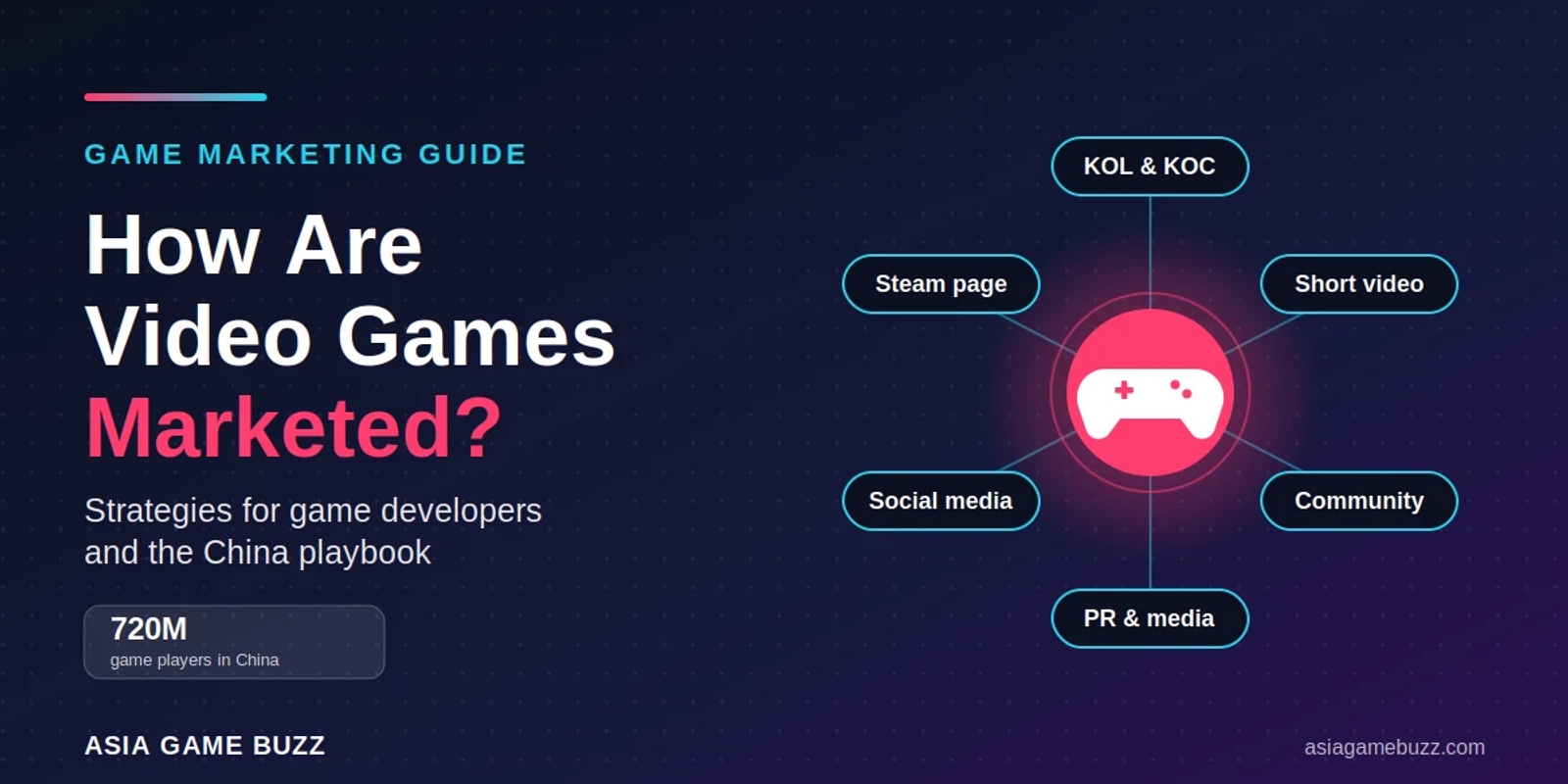
How are video games marketed? Video games are marketed through a mix of audience research, community building, creator partnerships, PR and media coverage, store-page optimization and paid ads, planned from early development through launch and beyond. The channels change by market, and nowhere more than in China.
A good game still needs marketing. The market is crowded, and players need a reason to pick your title over everything else. Marketing is not only for launch day either. It works best when it is built into the development plan from the start, with market research and early activity at the game's inception. The Game Developer guide covers the Western playbook well. This article adds the part most guides skip: how video game marketing works in China, where platforms, communities and rules are different.
This guide is for indie developers and publishers who want to reach Chinese players.
What Is Video Game Marketing in China?
Video game marketing is everything you do to make the right players aware of your game, interested in it and ready to buy it. In China, the goal is the same as in the West, but the route to the player is different.
How Chinese Game Marketing Differs From Western Marketing
Western playbooks lean on YouTube, Twitch, X, Reddit and Discord. In China, discovery runs through Bilibili, Douyin, Xiaohongshu, Weibo, QQ and WeChat. Short video has become a main way players find new games, and nearly 80% of premium PC players use Steam, mostly the international version without a VPN. A Western-only campaign never reaches this audience.
The scale is why it matters. About 720 million people play games in China. And a strong local campaign can move the numbers: Honkai: Star Rail secured millions of pre-registrations before launch and earned $40 million gross on its first day in China.
Core Goals: Wishlists, Community, Sales
Marketing a game has three linked goals. First, wishlists, which are your pre-launch demand signal on Steam. Second, an active community, which keeps players talking and returning. Third, sales and retention at and after launch. Each stage feeds the next.
Why Marketing Should Start Before Your Chinese Steam Page Goes Live
Chinese communities take time to grow, and creators need lead time. If your Chinese store page, trailer and community are not ready before launch, you lose the early wishlist momentum that decides visibility. Start months ahead, not weeks.
How to Market a Game in China Before Launch
Define Your Chinese Audience and Selling Points
Don't assume your Western audience maps onto China. Check which genres, art styles and mechanics Chinese players respond to, then choose two or three selling points to lead with. Genre tags, price expectations and community norms all shift.
Localize Your Steam Page and Trailer in Simplified Chinese
Localization is not translation. Rewrite your short description, feature list and trailer text in natural Simplified Chinese, and add Chinese subtitles or voice-over where it helps. Machine-translated pages put off players quickly.
Build Wishlists and Early Communities
Open a QQ group and a WeChat channel early, share development updates in Chinese and invite playtesters. A professional community management service for games in China can run this daily, so the group is active by launch.
Use Demos and Steam Next Fest in China
A localized demo gives Chinese players something to try, share and review. Use Steam Next Fest as a deadline: have your Chinese page, demo and creator outreach ready so the festival traffic converts into wishlists.
The Most Effective Game Marketing Channels in China
KOL and KOC marketing: best for trust and discovery, from pre-launch through launch.
Douyin and Bilibili short video: best for reach and wishlists, at every stage.
Xiaohongshu and Weibo seeding: best for awareness and social proof, mainly pre-launch.
Chinese gaming media: best for credibility, at launch.
QQ and WeChat communities: best for retention and feedback, at every stage.
Baidu SEO and content: best for long-term search traffic, always on.
KOL and KOC Marketing
KOLs (Key Opinion Leaders) bring reach; KOCs (Key Opinion Consumers) bring trust and engagement. The best campaigns layer both and match creators to your genre. See our guide to gaming influencer marketing campaigns for the full structure, or work with a team that runs KOL and influencer marketing for games in China end to end.
Short Video on Douyin and Bilibili
Short gameplay clips, devlogs and reaction videos travel fast on Douyin, while Bilibili rewards longer reviews and guides. Native formats and Chinese captions matter more than polish.
Xiaohongshu and Weibo Seeding
Seeding posts on Xiaohongshu and Weibo builds social proof among lifestyle and casual audiences. Managed well, social media marketing for games in China keeps your content consistent across these platforms.
Chinese Gaming Media and Press Releases
Coverage in Chinese gaming outlets builds credibility that Western press cannot. Press releases need to be written and localized for Chinese editors, not translated from English. Our game PR services in China handle distribution and outreach, and our guide to video game PR companies explains how to choose a partner.
Community Management on QQ and WeChat
Daily replies, contests, patch notes and player feedback keep a group alive. This is where wishlists turn into loyal players.
Baidu SEO and Chinese Content Marketing
Chinese-language articles, guides and a localized landing page capture search demand over time. Baidu is the main engine to optimize for.
Marketing a Steam Game to Chinese Players
Steam Reviews, Tags and Chinese Curators
Accurate tags help Steam show your game to the right people. Chinese reviews matter: players read them closely, so encourage genuine feedback and respond to it. Partnering with Chinese Steam curators adds another layer of trust.
Chinese Regional Pricing and Discount Timing
Set a yuan price that reflects local purchasing power rather than converting your US price directly, and plan launch discounts around local shopping moments. Price perception shapes reviews as much as quality does.
Launch Week Priorities
In launch week, focus on three things: a coordinated creator wave, active community channels and fast response to early reviews. Drive players to your store page from every channel with tracked links.
Marketing Mobile and Console Games in China
Licensing Requirements to Check First
Check licensing before you plan anything. China generally requires any game released or monetized in mainland China, whether mobile, PC or console, to hold a game publishing ISBN, and a foreign company cannot apply for it directly. Imported titles also face tighter quotas: as of May 2026, 25 imported games had been approved that year, against 754 domestic titles. Confirm your route with a qualified local partner.
TapTap and Chinese App Stores
For mobile, TapTap and Chinese Android stores are key discovery points, alongside Chinese platform channels. Each has its own listing and review requirements.
When a Local Publisher Is the Better Route
For mobile and console titles, a licensed Chinese publisher is usually the practical route, since it handles the ISBN, operations and compliance. Many indie PC developers instead start with Steam, where marketing can begin without that process.
How to Market an Indie Game in China on a Limited Budget
Prioritize Community and Micro-KOCs
On a small budget, community and micro-creators give the best return. A handful of well-matched KOCs often beats one expensive KOL. More tactics are in our game promotion ideas guide.
Use Demos and Chinese Player Feedback
Let a localized demo do the selling, then use player feedback to fix problems before launch.
Split Budget Between PR, Creators and Paid Ads
Weight spending toward community and creators first, PR second, and paid ads last, once you have tested what converts. Paid acquisition is getting more expensive worldwide: global mobile downloads fell 25% in H1 2026 while cost per install rose 30%. Test small before scaling.
How to Measure Game Marketing Results in China
Chinese Wishlists, Followers and Group Growth
Track wishlist growth by region, follower counts on Chinese platforms, QQ and WeChat group size, and how many members are active.
KOL Referral Traffic and Steam Sales
Use tracked links and promo codes for every creator, so you can compare which partnerships drive store visits, wishlists and sales.
Cost per Acquisition and ROI
Divide spend by wishlists and purchases per channel. Judge campaigns by long-term player value, not vanity metrics like views.
Common Mistakes When Marketing Games in China
Machine-Translated Store Pages
Poor Chinese copy signals low effort and hurts conversion and reviews.
Using Western Platforms Only
YouTube, Twitch and Reddit don't reach most Chinese players.
Starting Too Late
Communities and creator relationships take months. A late start means a quiet launch.
FAQ About Game Marketing in China
How are video games marketed in China? Through Chinese platforms and local partners: KOL and KOC creators, Douyin and Bilibili short video, Xiaohongshu and Weibo seeding, Chinese gaming media, QQ and WeChat communities, and a localized Steam page.
How much does game marketing in China cost? It depends on genre, scope and channel mix. A lean indie plan can start with community and micro-KOCs, while larger campaigns add top KOLs, PR and paid ads. Ask for a scoped quote rather than relying on averages.
How can indie developers promote games to Chinese players? Localize your Steam page, build a QQ or WeChat community early, work with micro-creators and use a demo.
What is the best game marketing strategy for China? There is no single one. The strongest plans combine community, creators and PR, and use paid ads only after testing.
When should I start marketing my game in China? As early as possible, ideally months before your Chinese Steam page goes live.
Conclusion: Build a China Marketing Plan Around Your Game
So, how are video games marketed? With a plan that starts early, knows its audience and uses the channels players actually use. In China, that means Chinese platforms, local creators, localized content and a clear view of licensing.
If you are planning a China launch, talk to Asia Game Buzz. We combine game PR, influencer marketing, community management and social media into one localized plan for your game.