
China remains the world’s largest gaming market by player base and one of the most closely regulated digital entertainment environments. That’s why gaming regulation news in China in 2026 is being monitored not only by domestic studios, but also by global publishers, investors, and platform operators.
Unlike markets where regulation follows disruption, China’s policy framework often shapes industry structure in advance. For companies exposed to the Chinese gaming sector, understanding regulatory direction is as important as analyzing revenue forecasts. Recent china gaming regulations news and draft rule proposals have once again highlighted how policy signals can influence valuations, publishing strategies, and monetization models worldwide.
Why China’s Gaming Regulations Matter Globally
China’s gaming sector influences:
- Global esports ecosystems
- Supply chains for development outsourcing
- Public market valuations of listed publishers
- Cross-border publishing partnerships
- Mobile free-to-play monetization standards
When china gaming regulation news updates emerge, international markets often react immediately — even before rules are finalized. This reflects China’s dual role as both a massive consumer market and a policy-driven regulatory system.
Oversight of the gaming industry falls under the authority of the National Press and Publication Administration (NPPA), whose approval lists and public notices are closely tracked by analysts.
A Brief History of Gaming Regulations in China
China’s approach to gaming regulation has evolved steadily over the past two decades. Early policies focused on content control and anti-addiction measures, while more recent frameworks expanded into monetization, data protection, and youth welfare.
Early regulations focused primarily on:
- Content censorship standards
- Cultural alignment requirements
- Real-name registration systems
Later phases introduced:
- Anti-addiction measures for minors
- Time limits for underage gameplay
- Monetization scrutiny (especially loot mechanics)
- Data governance and cybersecurity compliance
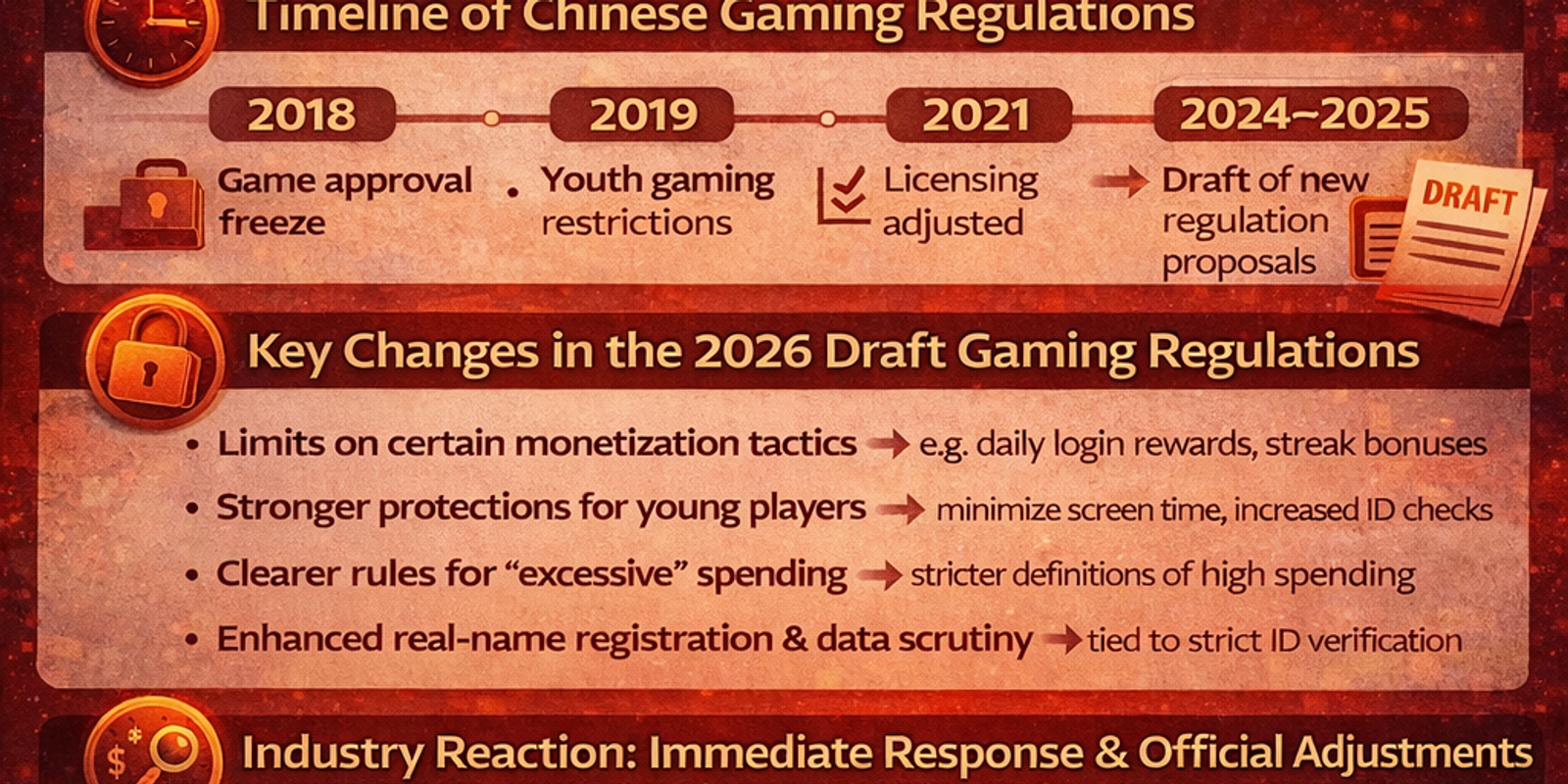
Key milestones included temporary game approval freezes and stricter enforcement of youth playtime limits. Each cycle reshaped publisher roadmaps and reinforced that china gaming news regulation is a structural factor — not a one-time disruption.
Overview of the New Draft Gaming Regulations
In late 2024 and through 2025, Chinese regulators released draft revisions to existing gaming rules, triggering widespread attention. These proposals, which continue to influence China gaming regulation news updates, signaled a more detailed and prescriptive approach to how games are designed, monetized, and operated.
The draft rules did not immediately become law, but they offered a clear policy direction—prompting both domestic and overseas stakeholders to reassess exposure to the Chinese market.
Key Restrictions Proposed in the 2026 Draft Rules
The proposed measures primarily targeted live-service and free-to-play models. Key areas included:
- Limits on certain daily login reward systems
- Scrutiny of streak-based incentive mechanics
- Stronger controls on underage spending
- Clearer definitions of “excessive consumption”
Because these systems represent core revenue drivers for many mobile and online titles, china gaming regulations news triggered immediate reassessment across development teams.
For live-ops designers, compliance now increasingly influences feature planning from the earliest product design phase.
Industry and Market Reaction to the New Regulations
The immediate reaction from the gaming industry and capital markets was sharp. Share prices of major Chinese gaming firms experienced short-term volatility, reflecting uncertainty rather than confirmed impact.
Industry responses included:
- Public statements emphasizing compliance readiness
- Internal audits of monetization systems
- Slower rollout of new features pending clarity
- Increased communication with regulators
International developers with China-facing titles also reassessed publishing partnerships and localization strategies.
Regulatory Rollbacks, Revisions, and Official Responses
Following industry feedback, regulators issued clarifications and signaled flexibility in implementation timelines.
Official messaging emphasized:
- Support for “healthy and sustainable development”
- Balanced supervision rather than suppression
- Protection of minors as a policy priority
This pattern — initial strict draft language followed by moderated refinement — has become characteristic of china gaming news regulation cycles.
For analysts, tone and clarification statements often carry as much weight as the draft text itself.
Game Approvals and Policy Signals Heading Into 2026
One of the strongest indicators of regulatory intent in China is the pace of game approvals. Over the past year, approval volumes have remained relatively stable, suggesting continuity rather than contraction.
Game approval trends indicate:
- Ongoing support for domestic game development
- Gradual openness to foreign titles through licensed partners
- Preference for culturally aligned and socially compliant content
These signals suggest that while regulatory scrutiny remains high, the government continues to view gaming as a legitimate pillar of the digital economy.
Oversight and approvals remain under the authority of National Press and Publication Administration, whose announcements are closely tracked by the industry.
Impact on Game Developers, Publishers, and Investors
For developers and publishers, the evolving rules mean compliance must be integrated early into game design, not added later. Systems related to monetization, progression, and user engagement are now routinely reviewed through a regulatory lens.
For investors, China gaming regulation news updates have reinforced several lessons:
- Regulatory risk is structural, not episodic
- Policy tone matters as much as policy text
- Long-term alignment with regulators reduces volatility
Many global investors now factor regulatory resilience into valuation models for China-exposed gaming firms.
What to Expect Next from China’s Gaming Regulators
Looking ahead to 2026, regulators are expected to focus on refinement rather than disruption. Likely areas of emphasis include:
- Enforcement consistency across provinces
- Clearer compliance standards for monetization
- Continued protection of minors
- Balanced oversight of emerging technologies such as AI-driven game features
Rather than sweeping bans, the direction points toward incremental rulemaking and stronger supervision.
Key Takeaways from China Gaming Regulation News in 2026
The latest China gaming regulation news in 2026 highlights a familiar but evolving pattern: strong regulatory oversight combined with pragmatic adjustments. While draft rules may initially appear restrictive, final outcomes often reflect economic realities and industry feedback.
For global stakeholders, the key is not to overreact to headlines, but to monitor approvals, official statements, and enforcement trends. China’s gaming market remains tightly regulated—but far from closed.